A brick looks like the simplest material on site — but its exact size controls your wall thickness, how courses line up at windows and lintels, and how many bricks to order. Sizes differ from country to country, and even within one country you will find an “actual” size (the brick itself) and a “nominal” size (the brick plus its mortar joint). Mixing them up is one of the most common estimation mistakes I see.
This guide compares the standard brick sizes used in Pakistan and around the world, explains actual vs nominal dimensions, and shows how to estimate brick quantities correctly.
Why Brick Sizes Differ
Historically, bricks were sized to fit a mason’s hand — which is why traditional bricks are smaller than concrete blocks. When countries industrialised, they standardised sizes so that courses of brickwork would align with door heights, floor levels, and each other. Because each country standardised at a different time, we ended up with different sizes:
- United Kingdom: metricated in 1970 (BS 3921, now BS EN 771-1)
- United States: the “modular” system based on 4-inch modules (BIA Technical Note 10, ASTM C216)
- India: modular brick standardised under IS 1077
- Pakistan: follows the British imperial tradition — bricks sized around the 9 × 4.5 × 3 inch nominal module
The key idea everywhere is the same: the nominal (coordinating) size = actual brick size + one mortar joint. In the UK that’s a 10 mm joint; in the US a 3/8-inch joint; in Pakistan roughly a 1/2-inch (13 mm) joint.
Standard Brick Size in Pakistan
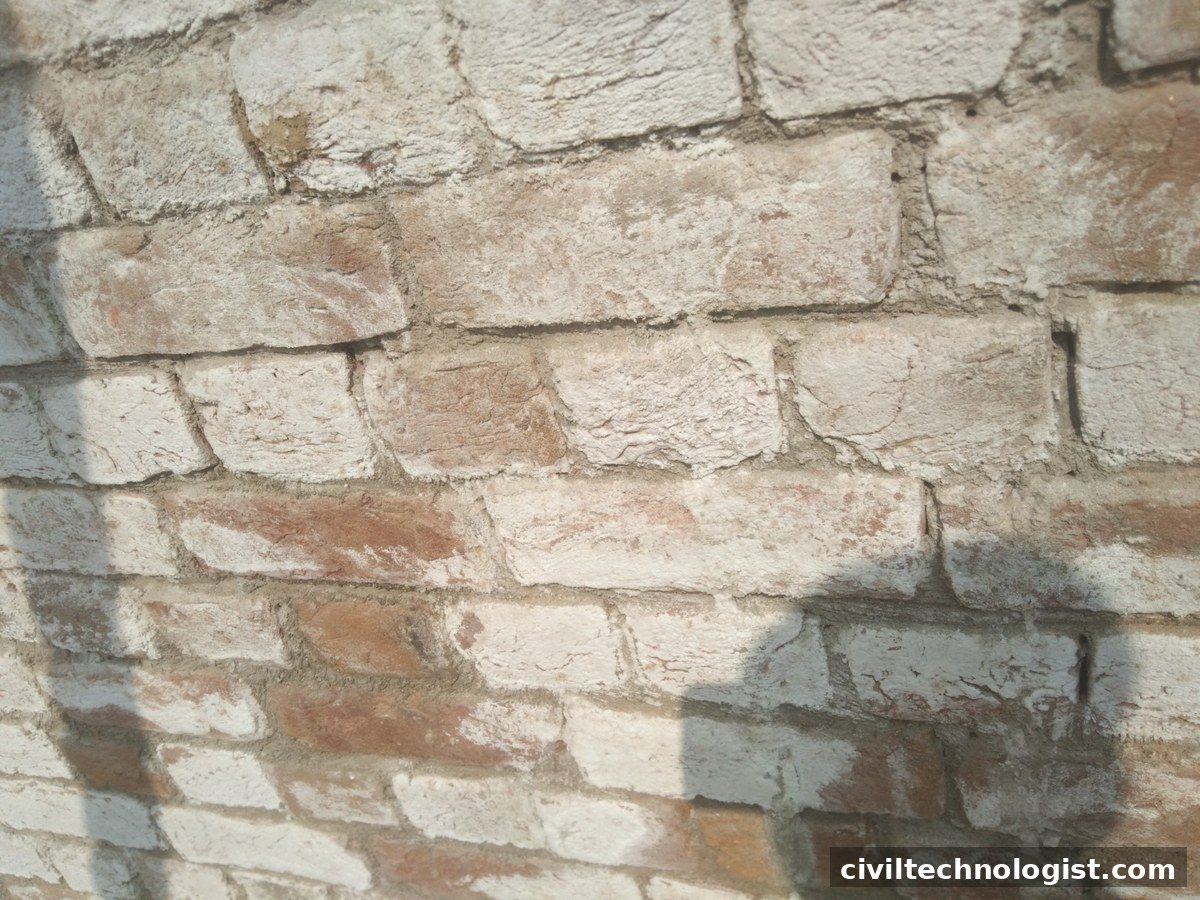
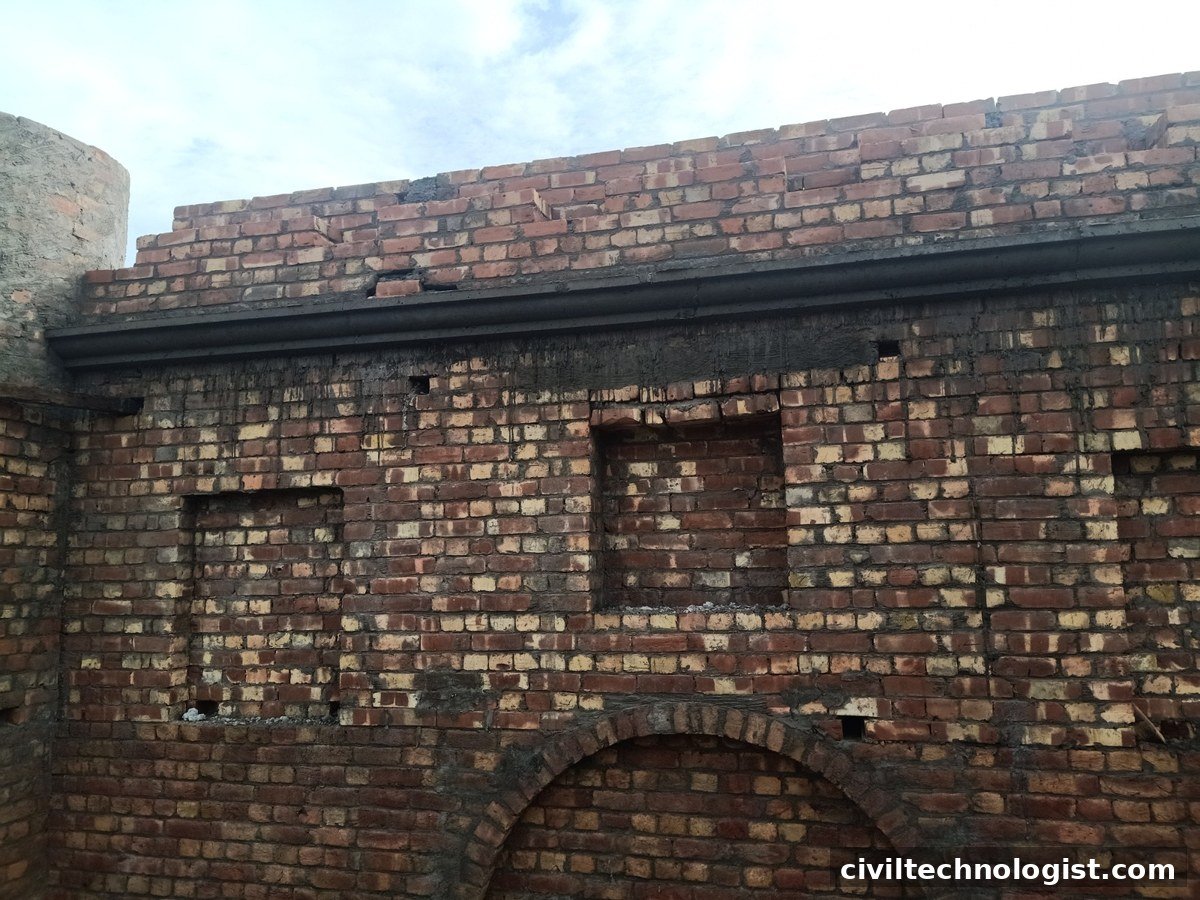
This is the size every Pakistani site, estimate, and quantity survey is built around:
| Dimension | Actual brick | Nominal (with mortar) |
|---|---|---|
| Length | ≈ 8.75 in (222 mm) | 9 in (230 mm) |
| Width | ≈ 4.25 in (108 mm) | 4.5 in (115 mm) |
| Height | ≈ 2.75 in (70 mm) | 3 in (75 mm) |
So a standard Pakistani brick measures roughly 222 × 108 × 70 mm and is taken as 9 × 4.5 × 3 in (230 × 115 × 75 mm) once laid with mortar. Common quality grades include first-class (well-burnt, good strength, low water absorption), second-class, and third-class bricks.
There is also the fair-face brick (gutka) used for exposed decorative brickwork, roughly 9 × 2.25 × 2.25 in (230 × 57 × 57 mm).
Practical note: Pakistani bricks vary more in size than imported machine-made bricks because most come from clamp kilns (bhattas) with hand moulding. Before starting masonry on any project, I lay out a sample course on the ground and check that four courses (three joints) stack up close to 300 mm — if the bricks run small or large, the course heights, sill levels, and lintel bearings all shift.
Brick Sizes Around the World
United Kingdom (BS EN 771-1)
The UK standard work size is 215 × 102.5 × 65 mm, with a 10 mm mortar joint giving a coordinating size of 225 × 112.5 × 75 mm. Four courses (three bricks high plus joints) equal exactly 300 mm, which is why UK wall heights are planned in 75 mm increments.
United States (ASTM C216, BIA)
The US uses two systems side by side:
- Modular brick: nominal 8 × 4 × 2⅔ in (203 × 102 × 68 mm); actual unit 7⅝ × 3⅝ × 2¼ in (194 × 92 × 57 mm) with a ⅜-in joint. Designed so that brickwork dimensions come out in whole 4-inch modules.
- Standard (non-modular) brick: 8 × 3⅝ × 2¼ in (203 × 92 × 57 mm), plus regional variants like Queen and King sizes.
India (IS 1077)
The Indian modular brick is 190 × 90 × 90 mm actual, becoming 200 × 100 × 100 mm nominal with mortar. India’s conventional (non-modular) brick is 230 × 110 × 70 mm — noticeably close to the Pakistani nominal size, reflecting the shared pre-partition brick-making tradition.
Other countries
- Nepal: 240 × 115 × 57 mm with 10 mm joints
- China: 240 × 115 × 53 mm (GB/T 5101)
- Australia: 230 × 110 × 76 mm
- South Africa: 222 × 106 × 73 mm
- Germany (DIN 105-1): NF format 240 × 115 × 71 mm
- Bangladesh: 241 × 114 × 70 mm (9½ × 4½ × 2¾ in) — close to the Pakistani size, from the same British imperial tradition
- Denmark: 228 × 108 × 54 mm (9 × 4¼ × 2¼ in) — a thinner brick than the German NF format
- Netherlands: 210 × 100 × 50 mm (≈ 8¼ × 4 × 2 in) (Waalformaat) — one of the smallest standard bricks in Europe, with a 65 mm Waaldikformaat variant
- Romania: 240 × 115 × 63 mm (9 × 4¼ × 2½ in)
- Russia: 250 × 120 × 65 mm (10 × 4¾ × 2½ in) (GOST 530) — the largest standard brick in this list
- Sweden: 250 × 120 × 62 mm (10 × 4¾ × 2½ in) — same length and width as the Russian brick, slightly thinner
- Japan: 210 × 100 × 60 mm (≈ 8¼ × 4 × 2⅜ in)
- Singapore: 218 × 100 × 68 mm (≈ 8⅝ × 4 × 2⅝ in)
- Malaysia: 215 × 102 × 70 mm (≈ 8½ × 4 × 2¾ in) for facing bricks (215 × 96 × 70 mm for common bricks)
- Canada: 203 × 92 × 57 mm (8 × 3⅝ × 2¼ in) — the same as the US standard brick
- UAE: 215 × 102.5 × 65 mm (8½ × 4 × 2½ in) — the British size, used across Gulf construction
South Asia:
Europe:
East and South-East Asia:
North America:
Middle East:
World brick size comparison table
| Country / region | Actual size (L × W × H, mm) | Nominal size (mm) | Governing standard |
|---|---|---|---|
| Pakistan | 222 × 108 × 70 | 230 × 115 × 75 | British imperial tradition (PS 208 referenced in specs) |
| United Kingdom | 215 × 102.5 × 65 | 225 × 112.5 × 75 | BS EN 771-1 |
| United States (modular) | 194 × 92 × 57 | 203 × 102 × 68 | ASTM C216, BIA TN 10 |
| United States (standard) | 203 × 92 × 57 | — (non-modular) | ASTM C216 |
| India (modular) | 190 × 90 × 90 | 200 × 100 × 100 | IS 1077 |
| Nepal | 240 × 115 × 57 | 250 × 125 × 67 | MRT guidelines |
| China | 240 × 115 × 53 | — | GB/T 5101 |
| Australia | 230 × 110 × 76 | — | AS/NZS 4455 |
| South Africa | 222 × 106 × 73 | — | SANS 227 |
| Germany (NF) | 240 × 115 × 71 | — | DIN 105-1 |
| Bangladesh | 241 × 114 × 70 (9½ × 4½ × 2¾ in) | — | British imperial tradition |
| Canada | 203 × 92 × 57 (8 × 3⅝ × 2¼ in) | — | Same as US standard (ASTM C216) |
| Denmark | 228 × 108 × 54 (9 × 4¼ × 2¼ in) | — | Danish standard |
| Japan | 210 × 100 × 60 (≈ 8¼ × 4 × 2⅜ in) | — | Japanese standard |
| Malaysia | 215 × 102 × 70 (≈ 8½ × 4 × 2¾ in) | — | Facing bricks (common: 215 × 96 × 70) |
| Netherlands | 210 × 100 × 50 (≈ 8¼ × 4 × 2 in) | — | Waalformaat |
| Romania | 240 × 115 × 63 (9 × 4¼ × 2½ in) | — | Romanian standard |
| Russia | 250 × 120 × 65 (10 × 4¾ × 2½ in) | — | GOST 530 |
| Singapore | 218 × 100 × 68 (≈ 8⅝ × 4 × 2⅝ in) | — | Singapore standard |
| Sweden | 250 × 120 × 62 (10 × 4¾ × 2½ in) | — | Swedish standard |
| UAE | 215 × 102.5 × 65 (8½ × 4 × 2½ in) | — | British size (BS EN 771-1) |
How to Estimate Bricks From Size
Once you know the size, quantity estimation is simple arithmetic:
Bricks required = Volume of brickwork ÷ Volume of one brick (nominal size, i.e. including the mortar joint)
Add 5–10% wastage for breakage.
Worked example (Pakistan): How many bricks for a 230 mm (9 in) thick, 3 m long, 3 m high wall?
- Wall volume = 0.23 × 3 × 3 = 2.07 m³
- One brick (nominal 9 × 4.5 × 3 in) = 0.2286 × 0.1143 × 0.0762 ≈ 0.00199 m³
- Bricks = 2.07 ÷ 0.00199 ≈ 1,040 bricks
- With 5% wastage: ≈ 1,095 bricks
A handy rule of thumb for Pakistani sites: roughly 500 bricks per cubic metre of 9-in brickwork (nominal size), or about 120–125 bricks per square metre of a 230 mm wall.
Practical note: Always estimate with the nominal (with-mortar) size, not the actual brick size — otherwise you’ll over-order by 15–20%. And remember to deduct openings (doors, windows) from the wall volume first.
Choosing and Checking Bricks on Site
Size is only half the story. Before accepting a brick delivery, check:
- Size consistency — stack 20 bricks and measure; length, width, and height should be within a few millimetres of each other.
- Shape and edges — sharp, straight edges; no warping.
- Sound — two bricks struck together should give a clear metallic ring, not a dull thud.
- Water absorption — first-class bricks should not absorb more than 20% water by weight after 24 hours of soaking (per IS 3495 / ASTM C67 test principles).
- Efflorescence — white salt patches on the face signal soluble salts that can damage plaster and paintwork later.
Brick Size and Wall Thickness: How Courses Add Up
Brick size does not just decide how many bricks you order — it decides the wall itself. With the Pakistani nominal brick of 230 × 115 × 75 mm, the wall thicknesses on every drawing follow automatically:
- Half-brick wall (single wythe): 115 mm — partition walls, usually with a plaster finish each side.
- One-brick wall: 230 mm — the standard external wall of a house.
- One-and-a-half-brick wall: 345 mm — heavy load-bearing walls and boundary walls.
The second number that matters is the course height: 75 mm (one brick plus one joint). Four courses make exactly 300 mm, so every height on a drawing should be planned in 75 mm steps: a window sill at 900 mm is 12 courses, a lintel bearing at 2,100 mm is 28 courses. When the sill height is not a multiple of 75 mm, the mason has to cut bricks or vary the joint thickness — and that is where uneven joints and weak courses start.
Practical note: before the first course is laid, mark the course heights on a storey rod (a straight timber batten with a mark every 75 mm) and stand it at the corner. It takes five minutes and it is the cheapest quality control on the whole job — every course, every opening and every lintel lines up.
The Frog, Perforations and Hollow Bricks
Pick up a brick and you will usually find a shallow rectangular depression pressed into one face. That is the frog, and it has two jobs: it gives the mortar a key to grip, so the bond between courses is stronger, and it makes the brick slightly lighter. A frogged brick is always laid frog-up, filled with mortar — a frog left empty is a hollow pocket in the middle of your wall.
Some bricks go further. Perforated bricks have holes right through them (usually 15–25% of the volume). They are lighter to carry, fire more evenly in the kiln, and use less clay — but the holes must be filled with mortar at the bed joint, or the wall loses strength. Hollow bricks and blocks take the same idea further for non-load-bearing partitions, where weight matters more than strength. On a load-bearing wall, use solid or frogged bricks; save perforated and hollow units for partitions and infill panels.
Size Tolerances: How Much Variation Is Allowed?
No two bricks from a clamp kiln are exactly the same size, and the standards accept that — they allow a few millimetres of variation in length, width and height. The practical question on site is not the standard’s exact tolerance figure, but whether the batch you received will still build a straight wall.
Use the stack test from the checking section: lay 20 bricks side by side and measure the total length, then stack 20 and measure the height. If individual bricks differ by more than about 5 mm from the standard size, the coursing will drift — joints will have to be made thicker in some places and thinner in others, and the wall face will wander. When a batch is that far out, sort it: use the most regular bricks for the face work and the worst for backing, or reject the batch and order from another kiln. Never try to hide bad sizing with thick mortar — a joint thicker than about 12 mm shrinks, cracks and weakens the wall.
How Brick Size Affects Cost and Mortar Use
A smaller brick does not just mean more bricks — it means more mortar, because there are more joints in every cubic metre of wall. Using the sizes already in this article’s comparison table:
| Brick | Nominal size (mm) | Bricks per m³ of wall | Mortar per m³ of wall |
|---|---|---|---|
| Pakistan (9 × 4.5 × 3 in) | 230 × 115 × 75 | ≈ 500 | ≈ 0.15 m³ wet (0.20 m³ dry) |
| India, modular | 200 × 100 × 100 | ≈ 500 | ≈ 0.23 m³ wet (0.31 m³ dry) |
Both sizes need about 500 bricks per cubic metre — but the taller Indian modular brick needs roughly 50% more mortar, because its joints are a bigger share of the wall. On a house with 40 m³ of brickwork, that is about 3 m³ of extra mortar — roughly 9 extra bags of cement and a full day of a mason’s time. This is why the estimate in this article must always use the nominal size and the local brick: a rate copied from another country’s brick size will under-order mortar every time.
Frequently Asked Questions
What is the standard brick size in Pakistan?
A standard Pakistani brick is about 222 × 108 × 70 mm (8.75 × 4.25 × 2.75 in), taken as 9 × 4.5 × 3 in (230 × 115 × 75 mm) with mortar joints.
What is the difference between actual and nominal brick size?
Actual size is the brick as manufactured; nominal size adds one mortar joint thickness. Estimates and drawings use the nominal size.
Why are bricks a different size in every country?
Because each country standardised brick dimensions at a different time to suit its own coursing and modular construction system. The UK metricated in 1970, the US uses 4-inch modules, and Pakistan follows the imperial 9 × 4.5 × 3 inch tradition.
How many bricks are in one cubic metre of brickwork?
For Pakistani 9-in brickwork (nominal size), roughly 500 bricks per m³, plus 5–10% wastage.
How many bricks are in one square foot of a 9-inch wall?
About 11 to 12 bricks. The article’s rule of thumb is 120–125 bricks per square metre of a 230 mm wall, and one square metre is 10.76 square feet, so 120 ÷ 10.76 ≈ 11 bricks per square foot. Always add 5–10% wastage on top.
What is the frog in a brick for?
The frog is the shallow depression pressed into one face of the brick. It keys the mortar into the brick for a stronger bond and makes the brick slightly lighter. Lay frogged bricks frog-up and fill the frog with mortar — an empty frog is a hollow pocket in the wall.
Can I use different-size bricks in the same wall?
No — not in the same panel. Different sizes break the coursing: joints will not line up, the wall face will step in and out, and openings will not match the lintel heights. If two batches differ, use each batch in a separate wall or panel, or sort the bricks and use the most regular ones for the face.
Written by Mohsin Raza Adil — BSc Civil Engineering Technologist (NTC-registered), Pakistan.

Mohsin Raza Adil
BSc Civil Engineering Technologist (NTC-registered), Pakistan. I write practical, field-tested guides on construction materials, soil testing and site engineering — the way it is actually done on site.
2 thoughts on “Brick Size Standards Around the World: Pakistan, UK, US, India & More”