Concrete Temperature: Limits, Measurement (ASTM C1064) and Hot/Cold Weather Practice
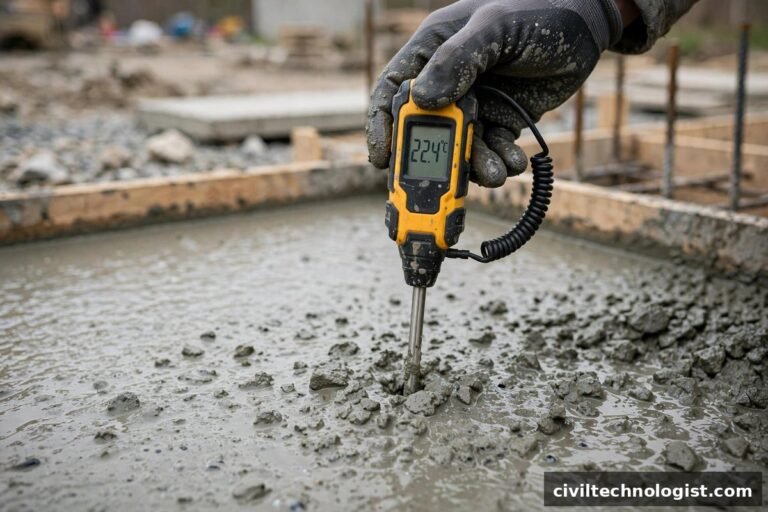
Concrete is a chemical reaction that happens to be a building material — and like every chemical reaction, its speed …
Concrete testing is a crucial aspect of construction projects, ensuring the quality, durability, and safety of structures. Various tests are conducted on concrete to assess its strength, consistency, and adherence to specified standards. These tests play a vital role in confirming that the concrete used in construction meets the necessary requirements for the intended application.
One of the fundamental tests for concrete is compressive strength testing. This test measures the ability of concrete to withstand axial loads or forces, providing insights into its overall strength. Another essential test is the slump test, which assesses the workability and consistency of fresh concrete, helping to determine its suitability for placement and compaction. Additionally, the concrete permeability test evaluates how easily water can penetrate the material, providing valuable information about its durability and resistance to environmental factors.
Concrete testing also includes assessments of the concrete’s density, moisture content, and air content. These properties influence the structural integrity and performance of the concrete over time. Moreover, tests such as the flexural strength test and modulus of elasticity test help engineers understand how concrete will behave under different types of loads and conditions.
Ensuring the quality of concrete is essential for preventing structural failures, increasing the lifespan of constructions, and minimizing maintenance costs. Contractors and engineers rely on accurate test results to make informed decisions during the construction process. By implementing rigorous concrete testing protocols, construction professionals can enhance the overall reliability and safety of their projects.
In summary, concrete testing is a comprehensive process that involves various tests to evaluate the strength, workability, durability, and other crucial properties of concrete. These tests are instrumental in maintaining construction standards and ensuring the long-term performance of structures.
Concrete is a chemical reaction that happens to be a building material — and like every chemical reaction, its speed …
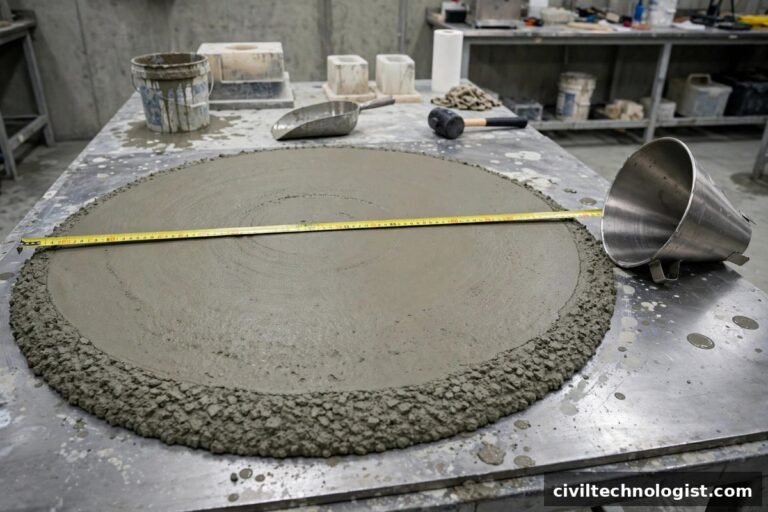
Self-Compacting Concrete (SCC): Complete Guide Watch any congested column being concreted on a Pakistani site and you will see the …

The slump flow test tells you how far self-compacting concrete spreads. The V-funnel test tells you something equally important: how …
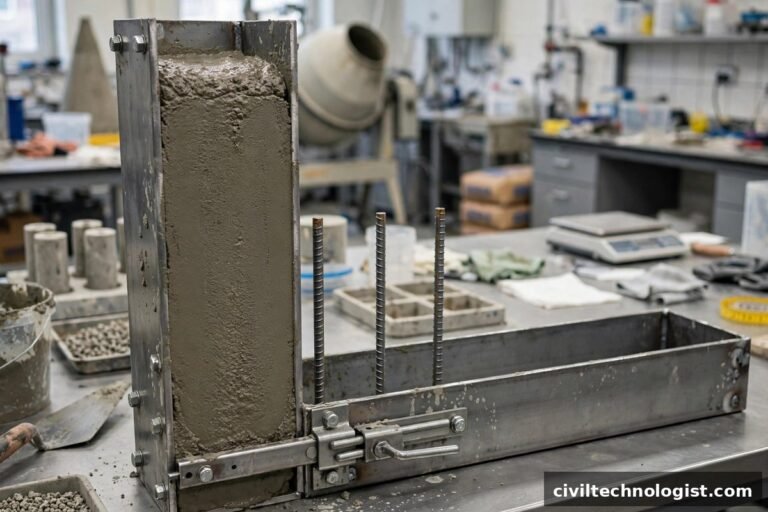
Slump flow tells you a self-compacting mix can spread. The L-box test answers the harder question: can it get through …
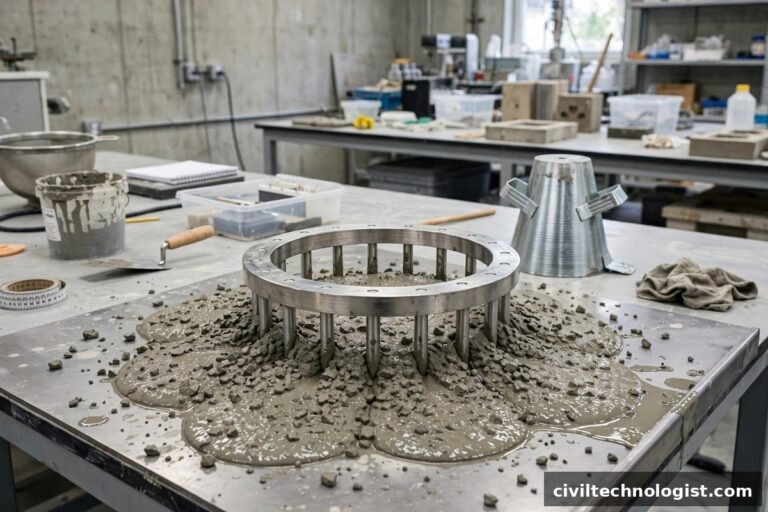
The J-ring is the site engineer’s passing-ability test. Where the L-box needs a heavy steel box and a lab bench, …
The slump flow test is the simplest and most widely used test for self-compacting concrete — and the first one …