Before a single footing is sized or a single layer of road subgrade is accepted, somebody has to answer one question: what is this soil, and what can it do? Soil tests are how we answer it.
This is the hub article for soil testing on civiltechnologist.com. Every common test is listed below with its purpose and governing standard, grouped into field tests (done on site) and laboratory tests (done on samples). Where we have a dedicated in-depth guide, it’s linked — use those for procedures, calculations, and report formats.
Practical note: No test is useful without a representative sample and honest recording. A perfect laboratory procedure on a disturbed, mislabelled sample produces a precise, worthless number. Sample correctly, label everything, and test promptly — that’s 80% of good geotechnical work.
Field (In-Situ) Tests
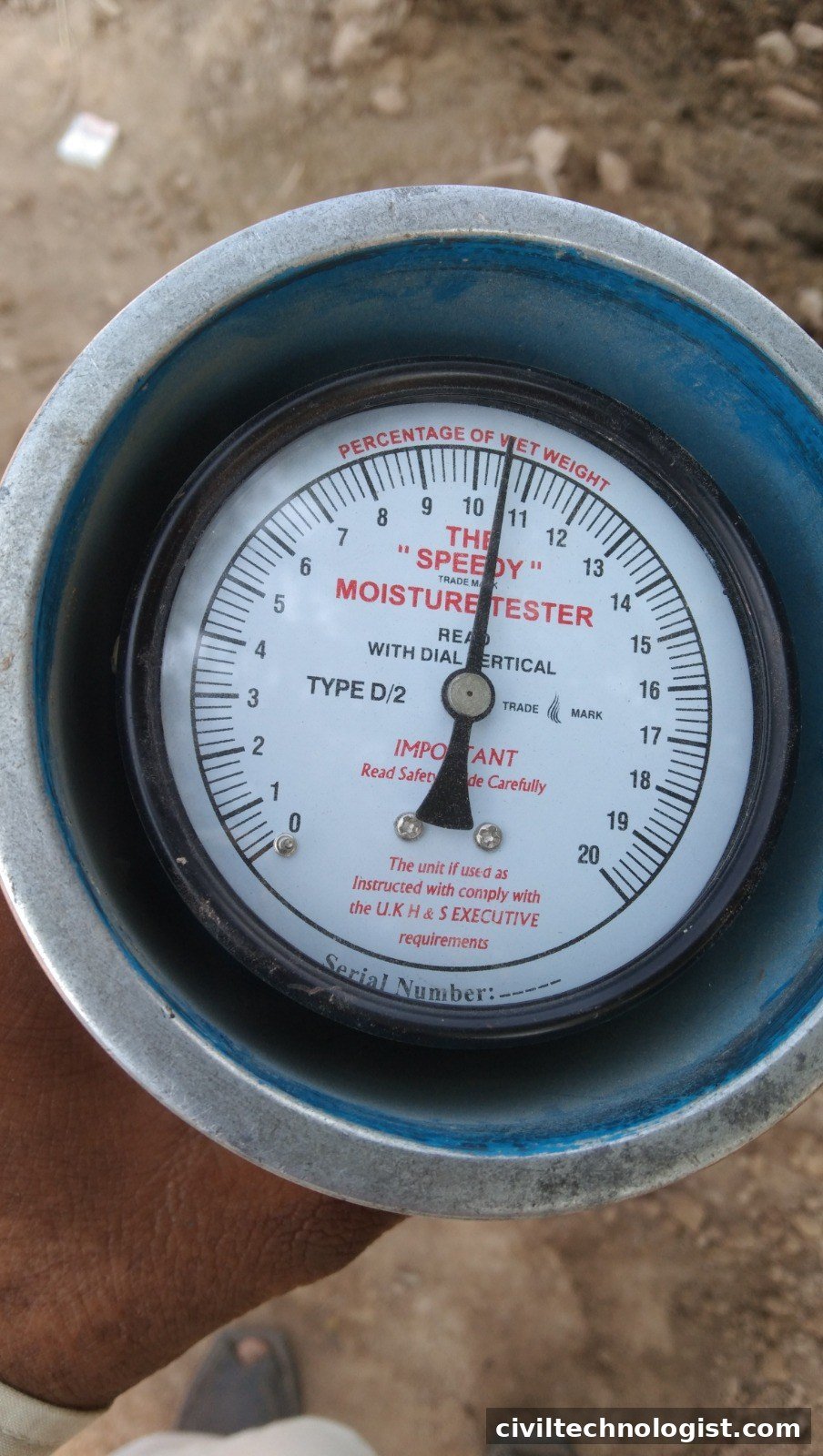
These are performed on the ground itself, in its natural or as-compacted condition.
1. Standard Penetration Test (SPT)
- Purpose: Measures the penetration resistance (N-value) of soil in a borehole — the most widely used indicator of density/strength for foundation design, and provides a disturbed sample for identification.
- Standard: ASTM D1586; BS EN ISO 22476-3.
- Key facts: 63.5 kg hammer dropped 760 mm; the sampler is driven 450 mm; the N-value is the blow count for the last 300 mm (the first 150 mm is the seating drive).
- Detailed guide: Standard Penetration Test (SPT)
2. Cone Penetration Test (CPT)
- Purpose: Continuous profiling of soil stratigraphy and strength by pushing an instrumented cone into the ground — faster and more continuous than SPT, but provides no physical sample.
- Standard: ASTM D5778; BS EN ISO 22476-1.
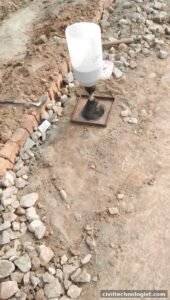
3. Field Density Test (Sand Cone Method)
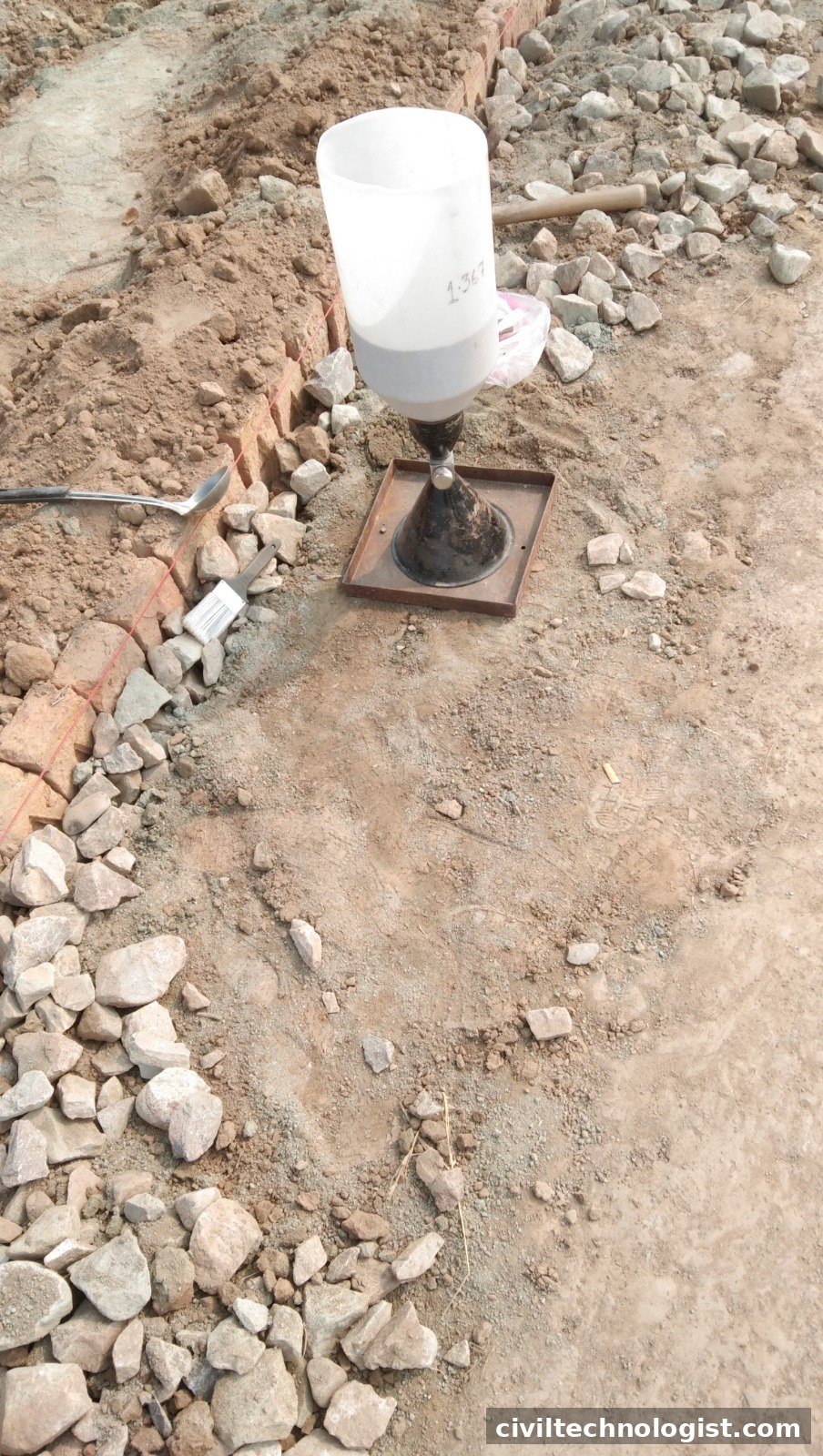
- Purpose: Determines the in-place dry density of compacted soil (subgrade, embankment, backfill) to verify the specified degree of compaction was achieved.
- Standard: ASTM D1556; AASHTO T 191. (BS 1377-9 covers the sand replacement method in the UK system.)
- Detailed guide: Field Density Test – Report Format
4. Nuclear Density Gauge Test
- Purpose: Rapid, non-destructive measurement of in-place density and moisture content of compacted layers — the fast alternative to the sand cone on large earthworks.
- Standard: ASTM D6938; AASHTO T 310. Requires licensed operators and radiation safety procedures.
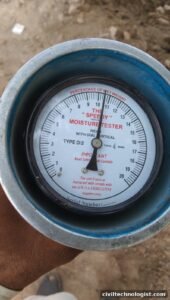
5. Speedy Moisture Test
- Purpose: Quick field determination of soil moisture content using calcium carbide reaction — essential during compaction, where moisture must stay near the optimum.
- Standard: ASTM D4944; AASHTO T 217.
6. Vane Shear Test
- Purpose: Measures the undrained shear strength of soft, saturated clays in situ — used where sampling would disturb the soil too much for lab testing.
- Standard: ASTM D2573.
7. Dynamic Cone Penetrometer (DCP)
- Purpose: Quick index of the strength/stiffness of subgrade and granular layers by measuring penetration per hammer blow — widely used for rapid road subgrade assessment.
- Standard: ASTM D6951.
8. Plate Load Test
- Purpose: Directly measures the bearing capacity and settlement characteristics of soil under a loaded plate — the closest field simulation of a footing.
- Standard: ASTM D1194.
9. Field CBR Test
- Purpose: In-place bearing strength of subgrade for pavement design, measured with the CBR plunger directly on the prepared surface.
- Standard: ASTM D4429; AASHTO T 193.
Laboratory Tests
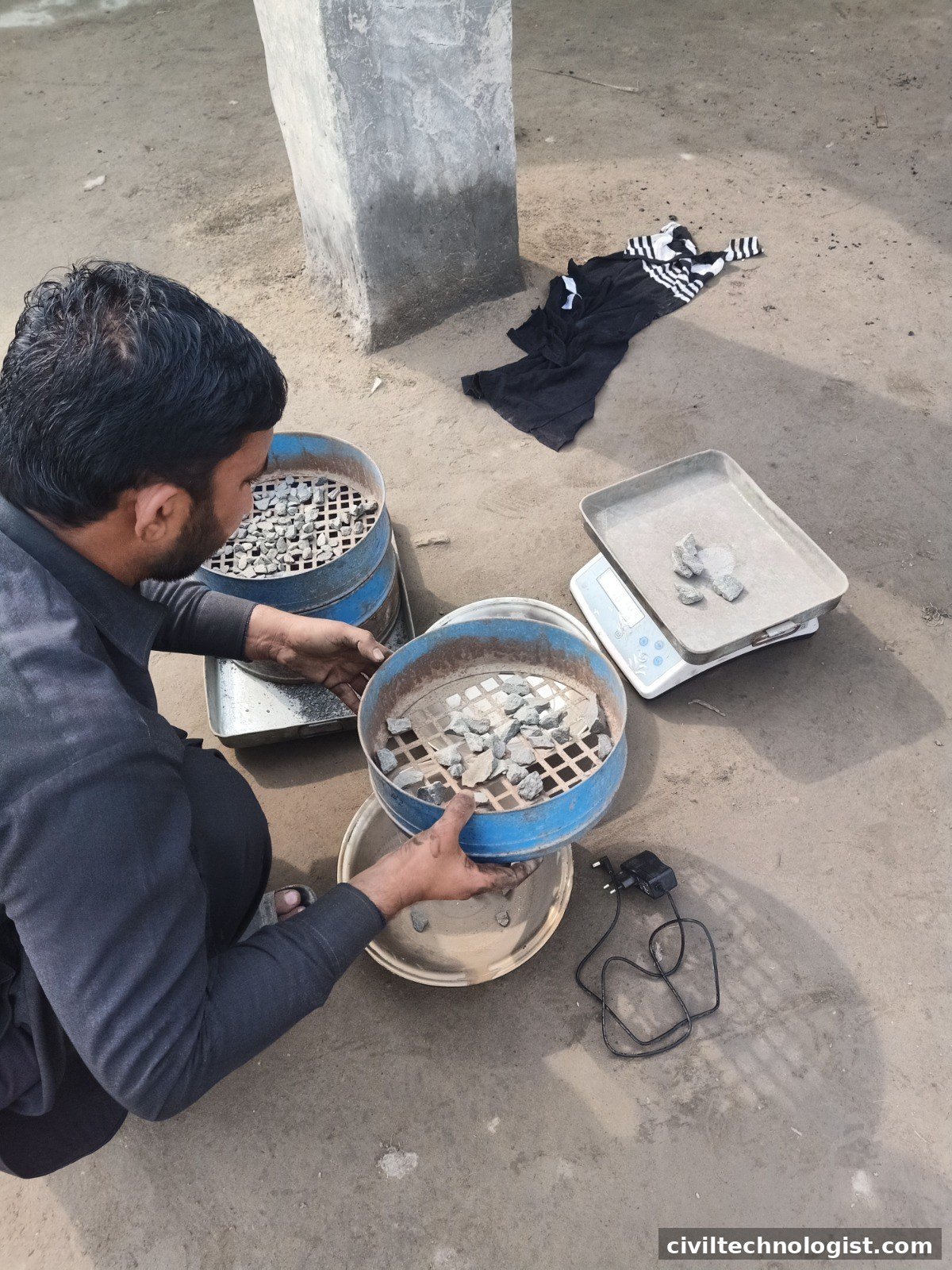
Performed on samples brought from site. These split naturally into identification/classification tests (what is it?), compaction tests (how do we compact it?), and strength/permeability tests (how does it behave under load and water?).
Identification and Classification
10. Moisture (Water) Content
- Purpose: The mass of water as a percentage of dry soil — the single most-reported soil property; affects compaction, strength, and classification.
- Standard: ASTM D2216 (oven-drying method).
11. Sieve Analysis (Gradation)
- Purpose: Determines the particle size distribution of coarse-grained soils and aggregates — the basis of acceptance for concrete aggregates, sub-base, and base course materials.
- Standard: ASTM C136 (aggregates) / ASTM D6913; AASHTO T 27.
12. Hydrometer Analysis
- Purpose: Particle size distribution of the fine fraction (silts and clays) that passes the No. 200 sieve — completes the gradation curve where sieves can’t reach.
- Standard: ASTM D7928 (ASTM D422 in older references); AASHTO T 88.
13. Atterberg Limits (Liquid Limit, Plastic Limit)
- Purpose: Defines the moisture boundaries between solid, plastic, and liquid states of fine-grained soils — the plasticity index derived from them is central to soil classification and swelling/shrinkage assessment.
- Standard: ASTM D4318; AASHTO T 89 (liquid limit), T 90 (plastic limit).
14. Specific Gravity of Soil Solids
- Purpose: Density of the soil particles themselves relative to water — needed for void ratio, porosity, and hydrometer calculations.
- Standard: ASTM D854; AASHTO T 100.
15. Soil Classification (USCS / AASHTO)
- Purpose: Assigns the soil a standard group symbol (e.g., SW, CL, A-2-4) from gradation and Atterberg results — the common language of geotechnical reports.
- Standard: ASTM D2487 (USCS); AASHTO M 145.
Compaction
16. Proctor Compaction Test (Standard and Modified)
- Purpose: Establishes the maximum dry density and optimum moisture content — the reference values against which field compaction (field density tests) is judged.
- Standard: ASTM D698 (standard effort) / D1557 (modified effort); AASHTO T 99 / T 180.
Strength, Permeability, and Consolidation
17. California Bearing Ratio (CBR) — Laboratory
- Purpose: Measures the penetration resistance of compacted subgrade/sub-base material relative to standard crushed rock — the primary design input for flexible pavements.
- Standard: ASTM D1883 (lab-compacted); AASHTO T 193; BS 1377-4.
- Detailed guide: California Bearing Ratio Test for Soil
18. Permeability Test — Constant Head
- Purpose: Measures the hydraulic conductivity (k) of coarse-grained soils — how fast water flows through them; needed for drainage design and seepage analysis.
- Standard: ASTM D2434; AASHTO T 215.
19. Permeability Test — Falling Head
- Purpose: Measures hydraulic conductivity of fine-grained soils (silts, clays), where flow is too slow for the constant head method.
- Standard: BS 1377-5 (falling head permeability).
- Detailed guide: Falling Head Permeability Test of Soil
20. Consolidation (Oedometer) Test
- Purpose: Measures how much a saturated clay compresses under load and how fast — predicts foundation settlement magnitude and time rate on clay soils.
- Standard: ASTM D2435; AASHTO T 216.
- Detailed guide: The Ultimate Guide to the Consolidation Test
21. Direct Shear Test
- Purpose: Determines the shear strength parameters (cohesion c and friction angle φ) of soil by shearing it along a plane — basic input for slope stability and retaining wall design.
- Standard: ASTM D3080; AASHTO T 236.
22. Triaxial Compression Test
- Purpose: The most versatile strength test — measures shear strength under controlled drainage conditions (UU, CU, CD variants) on cylindrical specimens.
- Standard: ASTM D2850 (UU), D4767 (CU), D7181 (CD); AASHTO T 234.
23. Unconfined Compression Test
- Purpose: Quick measure of the undrained shear strength of cohesive soils — a single, simple loading to failure with no confining pressure.
- Standard: ASTM D2166; AASHTO T 208.
A Practical Testing Sequence for a Typical Project
Tests are most valuable when ordered in a logical sequence. For a building project:
- Reconnaissance + boreholes with SPT — establish the strata and get N-values (tests 1, 10).
- Classification tests on samples — sieve/hydrometer, Atterberg limits, specific gravity (tests 11–15).
- Strength and settlement tests — consolidation for clays, shear/triaxial for design parameters (tests 20–22).
- During construction — Proctor reference values first (test 16), then field density and moisture control on every compacted layer (tests 3, 5), plus concrete QC in parallel.
For a road project, add CBR (lab and field), aggregate gradation, and DCP profiling to the sequence. The point: investigate before designing, and control during construction. Testing after failure is archaeology, not engineering.
Frequently Asked Questions
Which soil test is done first on a new site?
The site investigation comes first — boreholes with SPT, plus disturbed samples for moisture content and classification. You need to know what the ground is before choosing any other test.
What is the difference between SPT and CPT?
SPT (ASTM D1586) drives a sampler with a hammer and yields both an N-value and a physical sample; CPT (ASTM D5778) pushes an instrumented cone continuously and yields a detailed strength profile but no sample. They complement each other.
Why is the field density test important?
Because design assumptions about compacted fill are worthless unless verified. The sand cone test (ASTM D1556 / AASHTO T 191) confirms each compacted layer actually achieved the specified percentage of the Proctor maximum dry density.
What does the CBR value tell us?
It compares the soil’s penetration resistance to that of standard crushed rock (defined as 100%). Higher CBR means stronger subgrade and thinner required pavement layers. Typical values: clays 1–3%, sandy clays 4–7%, well-graded sands 15–40%.
Which standard should I follow — ASTM, AASHTO, or BS?
Follow your project’s specifications. ASTM governs general materials testing, AASHTO is highway-oriented, and BS/BS EN is the UK/European system. Pakistani public works often reference AASHTO and ASTM; always check the contract documents.
Final Thoughts
Keep this list as your reference map. Every test here answers a specific question about the ground — learn which question each one answers, and you’ll know exactly what to order, when to order it, and how to read the results when they come back. The dedicated guides linked above take you deeper into the five tests you’ll meet most often.
Written by Mohsin Raza Adil — BSc Civil Engineering Technologist (NTC-registered), Pakistan.

Mohsin Raza Adil
BSc Civil Engineering Technologist (NTC-registered), Pakistan. I write practical, field-tested guides on construction materials, soil testing and site engineering — the way it is actually done on site.
2 thoughts on “Soil Tests Used in Civil and Geotechnical Engineering – Complete List”