What Is the Penetration Test of Bitumen?
The penetration test is the most fundamental test performed on bitumen. It determines the consistency (hardness or softness) of bitumen by measuring how deep a standard needle penetrates into a bitumen sample under fixed conditions of load, temperature, and time.
In simple words: a needle is pressed into bitumen for 5 seconds, and we measure how far it goes in. The deeper it goes, the softer the bitumen. This single number decides the penetration grade of the bitumen — and the grade decides where that bitumen can be used in road construction.
If you work on road projects, this is one test you will see in almost every bitumen approval report, from NHA projects in Pakistan to highway jobs in the Gulf.
Purpose of the Penetration Test
- To determine the consistency (hardness/softness) of bitumen.
- To classify bitumen into penetration grades (e.g., 60/70, 80/100).
- To select the right bitumen grade for the climate and traffic conditions of a project.
- To check uniformity of bitumen supplied to site — a sudden change in penetration value means the source or batch has changed.
Golden rule: Higher penetration value = softer bitumen. Lower penetration value = harder bitumen.
Principle of the Test
A standard needle, loaded to a total of 100 g, is allowed to penetrate vertically into a bitumen sample maintained at 25°C for exactly 5 seconds. The depth of penetration is measured in tenths of a millimetre (0.1 mm), a unit called the decimillimetre (dmm).
For example, if the needle sinks 6.0 mm into the sample, the penetration value is reported as 60 dmm — not 6 mm. This is the single most common MCQ trap on this topic.
Standard Test Conditions
| Parameter | Standard Value |
|---|---|
| Test temperature | 25 ± 0.1°C |
| Total load on needle | 100 g |
| Loading time | 5 ± 0.1 seconds |
| Penetration unit | 0.1 mm (dmm) |
These three conditions — 100 g, 25°C, 5 s — are identical in every major standard in the world (ASTM, IS, BS EN). If any one of them changes, the result is not comparable. That is why temperature is controlled in a water bath accurate to 0.1°C: bitumen consistency is extremely temperature-sensitive.
Apparatus: The Penetrometer
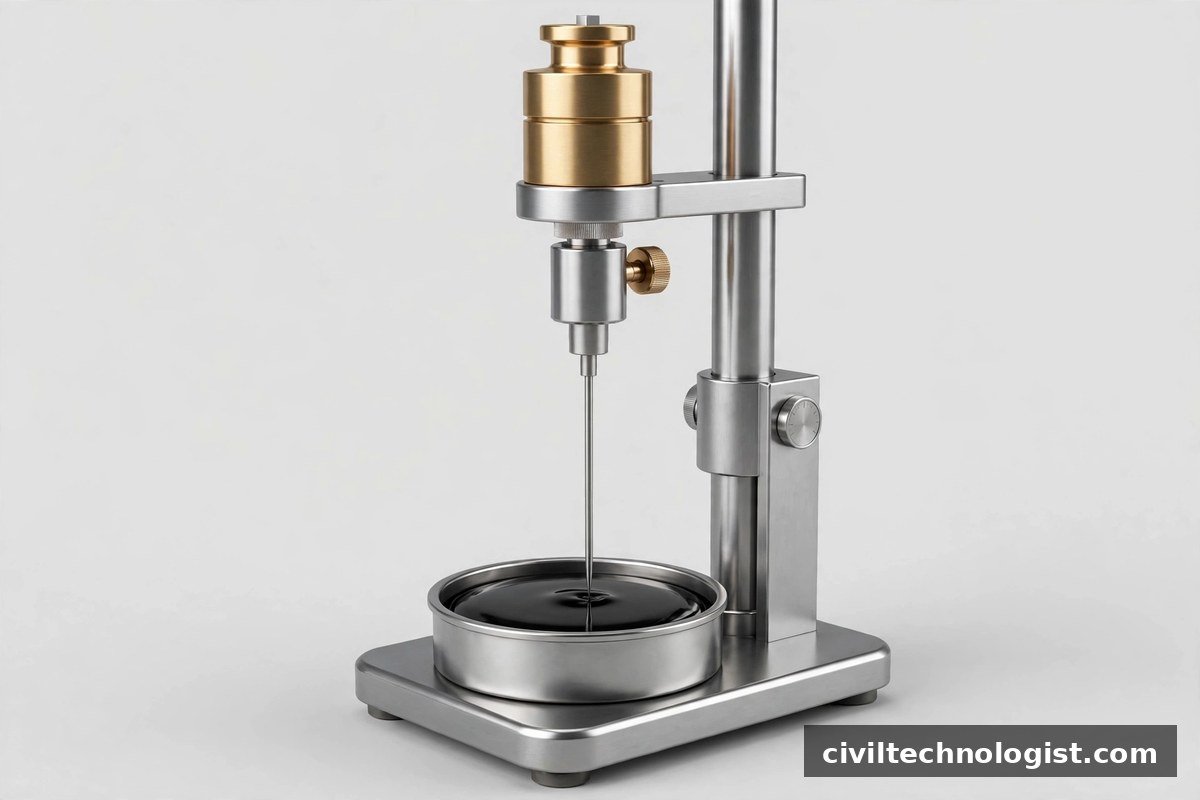
The apparatus is called a penetrometer. Its main parts are:
- Stand and base — holds everything vertical and stable.
- Needle — a standard hardened steel needle, weight 2.50 ± 0.05 g, diameter 1.00–1.02 mm.
- Spindle/plunger — needle + spindle together weigh 50.0 ± 0.05 g.
- Surcharge weight — an additional 50 g weight, bringing the total moving load to exactly 100 g.
- Sample container — a flat-bottomed metal dish, about 55 mm diameter × 35 mm deep.
- Water bath — maintains the sample at 25°C.
- Timing device — accurate to 0.1 s, to release and stop the needle at exactly 5 seconds.
Sample Preparation
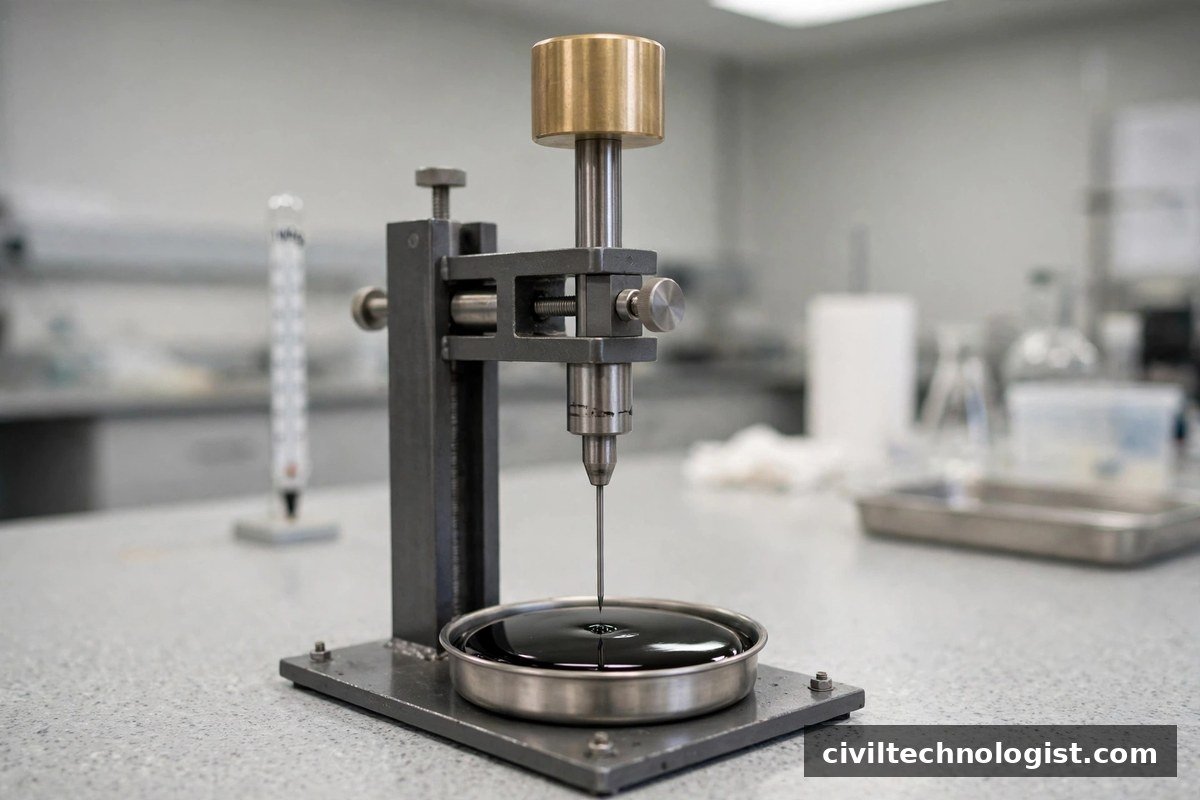
- Heat the bitumen sample until it is fluid enough to pour — but never overheat it. For petroleum asphalt, do not heat more than about 90°C above its expected softening point. Overheating hardens the bitumen and gives a falsely low penetration.
- Pour the sample into the container without trapping air bubbles. Stir gently if needed, then let air bubbles escape.
- Cool the filled container at room temperature, then condition it in the 25°C water bath for the specified time before testing.
- The sample surface must be level and the needle must enter vertically — a tilted needle gives a wrong reading.
Test Procedure (Step by Step)
- Place the conditioned sample container on the penetrometer base, under the needle.
- Clean the needle with a suitable solvent and dry it before every penetration.
- Lower the needle slowly until its tip just touches the bitumen surface (watch the reflection — the tip and its mirror image should just meet).
- Release the needle assembly and start the timer simultaneously. Let it penetrate for exactly 5 seconds.
- Lock the spindle and read the penetration dial in dmm (0.1 mm).
- Make at least three determinations on the same sample: each point at least 10 mm from the container edge and at least 10 mm away from the previous point.
- Report the mean of the valid determinations as the penetration value.
Field tip: If the three readings scatter more than the repeatability limit of the standard, discard and repeat the test on a fresh sample. On site, the most common cause of scattered readings is a sample that was overheated during preparation.
Calculation and Result — Worked Example
Suppose three penetration readings on a sample are:
- Trial 1 = 65 dmm
- Trial 2 = 68 dmm
- Trial 3 = 67 dmm
Average = (65 + 68 + 67) ÷ 3 = 66.7 dmm
A mean penetration of 66.7 falls in the 60–70 range, so this bitumen is classified as penetration grade 60/70.
Penetration Grades Explained
Bitumen is designated by its penetration range. Common grades:
| Grade | Penetration Range (dmm) | Nature |
|---|---|---|
| 40/50 | 40–50 | Hard |
| 60/70 | 60–70 | Medium-hard — the most common paving grade |
| 80/100 | 80–100 | Soft |
| 100/120 and above | 100+ | Softer grades |
Remember the order: 40/50 < 60/70 < 80/100 in penetration value — and hardness runs in exactly the opposite direction.
Country-Wise Standards and Specifications
The test conditions (100 g, 25°C, 5 s) are the same worldwide, but every country writes its own standard and uses its own grade system. Here is the complete picture:
| Country / Region | Test Standard | Grade System | Common Grades |
|---|---|---|---|
| Pakistan & India | IS 1203 | IS 73:2013 (viscosity grades, with penetration limits) | VG-10 (80+ dmm), VG-20 (60+), VG-30 (45+), VG-40 (35+); older pen grades 60/70, 80/100 still widely used — NHA Pakistan commonly specifies 60/70 |
| USA | ASTM D5/D5M, AASHTO T 49 | ASTM D946 (penetration-graded asphalt cement) | 40-50, 60-70, 85-100, 120-150, 200-300 |
| UK & Europe | BS EN 1426 | EN 12591 | 35/50, 50/70, 70/100, 100/150 (also 20/30, 160/220) |
| Australia | AS 2341.12 | AS 2008 (viscosity classes) | Class 170, Class 320, Class 600 (penetration reported as a check value) |
| South Africa | EN 1426 (SANS 4001-BT1) | SANS 4001-BT1 | 50/70 (most common paving grade) |
| Middle East / Gulf | ASTM D5 | ASTM D946 | 60/70, 85/100 (as per project specs) |
Pakistan and India — IS 1203 and IS 73
In Pakistan and India the test itself follows IS 1203, and the material specification is IS 73:2013, which grades paving bitumen by viscosity (VG-10 to VG-40) while still setting minimum penetration values: VG-10 needs 80+ dmm, VG-20 needs 60+, VG-30 needs 45+, and VG-40 needs 35+. On most Pakistani road projects, however, you will still see the classic 60/70 penetration grade written in the specifications — it remains the workhorse grade for our climate.
USA — ASTM D5 and AASHTO T 49
The American test method is ASTM D5/D5M (identical to AASHTO T 49). Penetration-graded asphalt cements follow ASTM D946: 40-50, 60-70, 85-100, 120-150, and 200-300. Note that the USA has largely moved to performance grading (PG system, AASHTO M 320), but penetration is still the referee test everywhere.
UK and Europe — BS EN 1426
Europe tests penetration under BS EN 1426 and grades bitumen under EN 12591: 35/50, 50/70, 70/100, 100/150 are the everyday paving grades. The numbers look slightly different from the American system, but the test behind them is the same 100 g / 25°C / 5 s.
Australia — AS 2341.12
Australia measures penetration under AS 2341.12 but grades its binders by viscosity (AS 2008) — Class 170 and Class 320 are the standard paving classes, roughly matching a 60/70-type binder.
Selecting the Grade by Climate
| Climate | Recommended Grade Type | Example |
|---|---|---|
| Hot climate | Lower penetration — harder bitumen (resists rutting) | 40/50, 60/70 |
| Moderate climate | Medium penetration | 60/70, 80/100 |
| Cold climate | Higher penetration — softer bitumen (resists cracking) | 80/100, 100/120 |
This is a general rule, not the whole story: final grade selection also depends on traffic loading, pavement design, and the project specifications. In Pakistan’s hot plains, 60/70 is the default choice; in the colder northern areas, softer grades perform better.
Precautions
- Do not overheat the sample during preparation — overheating changes the bitumen properties.
- Pour without entrapping air; air bubbles under the needle give false high readings.
- Keep the sample truly level and the needle truly vertical.
- Clean and dry the needle before every single penetration.
- Maintain the water bath at 25 ± 0.1°C — even a 1°C drift shifts the result.
- Respect the spacing rules: ≥10 mm from the edge, ≥10 mm between points.
- Release the needle smoothly — dropping it adds impact load.
- Take at least three readings and average the valid ones.
Common MCQ Traps (Read Carefully)
- The penetration test measures consistency — it does not directly measure viscosity or softening point.
- The unit is dmm (0.1 mm) — 60/70 does not mean 60–70 mm, it means 6–7 mm.
- Higher penetration = softer bitumen. Students routinely reverse this under exam pressure.
- 60 penetration means the needle sank 6.0 mm.
- The test is not used for tar (tar is tested by viscosity).
Penetration Test vs Other Bitumen Tests
Penetration alone does not fully characterize bitumen. A complete binder testing suite includes:
| Test | What It Measures | Common Standards |
|---|---|---|
| Penetration | Consistency (hardness/softness) | ASTM D5, IS 1203, BS EN 1426 |
| Softening point (Ring & Ball) | Temperature at which bitumen softens | ASTM D36, IS 1205, BS EN 1427 |
| Ductility | Stretching ability before breaking | ASTM D113, IS 1208 |
| Viscosity | Resistance to flow | ASTM D2171, IS 1206 |
| Flash & fire point | Safe heating temperature | ASTM D92, IS 1448 |
| Specific gravity | Density relative to water | ASTM D70, IS 1202 |
Interview Questions and Answers
Q: What does the penetration test determine?
A: The consistency (hardness/softness) of bitumen.
Q: What are the standard test conditions?
A: 100 g load, 25°C temperature, 5 seconds time.
Q: What is the unit of penetration?
A: 0.1 mm, called the decimillimetre (dmm).
Q: What does 60/70 grade mean?
A: The penetration lies between 60 and 70 dmm under standard conditions.
Q: Which is harder — 40/50 or 80/100?
A: 40/50.
Q: Why is temperature so tightly controlled?
A: Because bitumen consistency is highly temperature-sensitive; even small drifts change the result.
Q: How many determinations are made?
A: At least three, averaged.
FAQs
Q: What is the penetration value of 60/70 bitumen in mm?
A: 6.0 to 7.0 mm. The grade number is in dmm (tenths of a millimetre), so divide by 10.
Q: Which bitumen grade is used in Pakistan?
A: 60/70 penetration grade is the most common on Pakistani road projects (NHA specifications), with 80/100 used in cooler regions.
Q: What is the difference between penetration grade and viscosity grade?
A: Penetration grade (e.g., 60/70) classifies bitumen by needle penetration at 25°C. Viscosity grade (e.g., VG-30) classifies it by viscosity at 60°C. India and Pakistan officially use VG grades under IS 73:2013, but penetration is still measured as a check.
Q: Can the penetration test be done on tar?
A: No — tar is tested by viscosity, not penetration.
Related Articles
- Roads and Their Types: A Practical Guide
- 12 Lab Tests for WBM Road Quality Control
- Aggregate Crushing Value Test: Procedure, Calculation, and Limits
- Super Elevation in Road Design

Mohsin Raza Adil
BSc Civil Engineering Technologist (NTC-registered), Pakistan. I write practical, field-tested guides on construction materials, soil testing and site engineering — the way it is actually done on site.