Every concrete grade you see on a drawing — M25, C30/37, 4000 psi — is a promise about one property: compressive strength. It is the most tested, most specified, and most argued-over number in concrete construction. This article explains what f’c and fck mean, how cube and cylinder tests differ, the formula with worked examples, what affects the result, and the acceptance criteria that decide whether a pour passes.
For where this test sits among all the others, see the complete list of concrete tests.
What f’c and fck Mean
- f’c (ACI/ASTM notation) — the specified compressive strength of concrete, normally the 28-day cylinder strength the design is based on.
- fck (Eurocode/IS notation) — the characteristic compressive strength, the strength below which no more than 5% of test results should fall.
In both systems, the number on the drawing is not the average you expect — it is a lower-bound value the concrete must reliably achieve. That is exactly why acceptance criteria (below) allow some individual results under the specified value while the averages must stay above it.
Cube Test vs Cylinder Test
Which specimen you crush depends on which code tradition your project follows:
| Point | Cube test | Cylinder test |
|---|---|---|
| Specimen | 150 × 150 × 150 mm cube | 150 mm diameter × 300 mm high cylinder |
| Code tradition | BS / EN / IS (UK, Europe, Pakistan, India) | ASTM / ACI (USA and ACI-based specs) |
| Height-to-width ratio | 1.0 | 2.0 |
| Typical result | Higher | Lower — about 0.8 × cube strength |
Why the difference? The platens of the testing machine confine the ends of the specimen. In a short cube, that confinement affects the whole specimen and raises the apparent strength. In a slender cylinder (h/d = 2), the middle fails in something closer to true uniaxial compression. The widely used conversion is:
Cylinder strength ≈ 0.80 × Cube strength
(Eurocode 2 / EN 206 uses this 0.80 factor for strength classes up to C55/67; research shows the real ratio ranges roughly 0.78–0.83.) So a C30/37 concrete means 30 MPa cylinder strength and 37 MPa cube strength — the two numbers in the grade name are the same concrete described both ways.
The Test Procedure
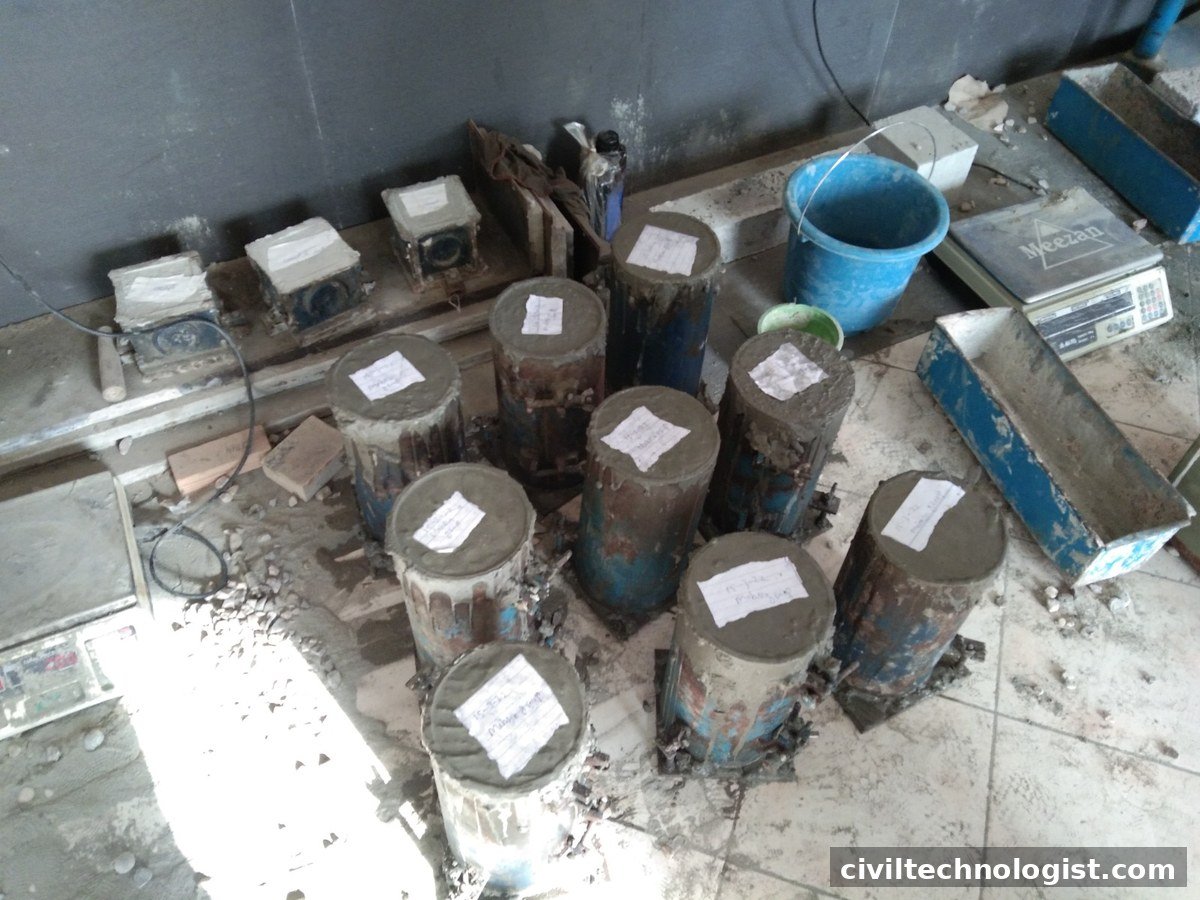
- Cast specimens from the fresh concrete in standard steel moulds — cubes in three layers, each rodded 35 times (or vibrated), cylinders similarly compacted. Mark every specimen with pour ID and date.
- Cure for 24 hours in the moulds, then demould and cure in water at controlled temperature until the test age — normally 7 and 28 days.
- Prepare the bearing faces: they must be flat and parallel. Cylinders are usually capped (with sulphur compound or neoprene pads); cubes are tested on faces perpendicular to the casting face.
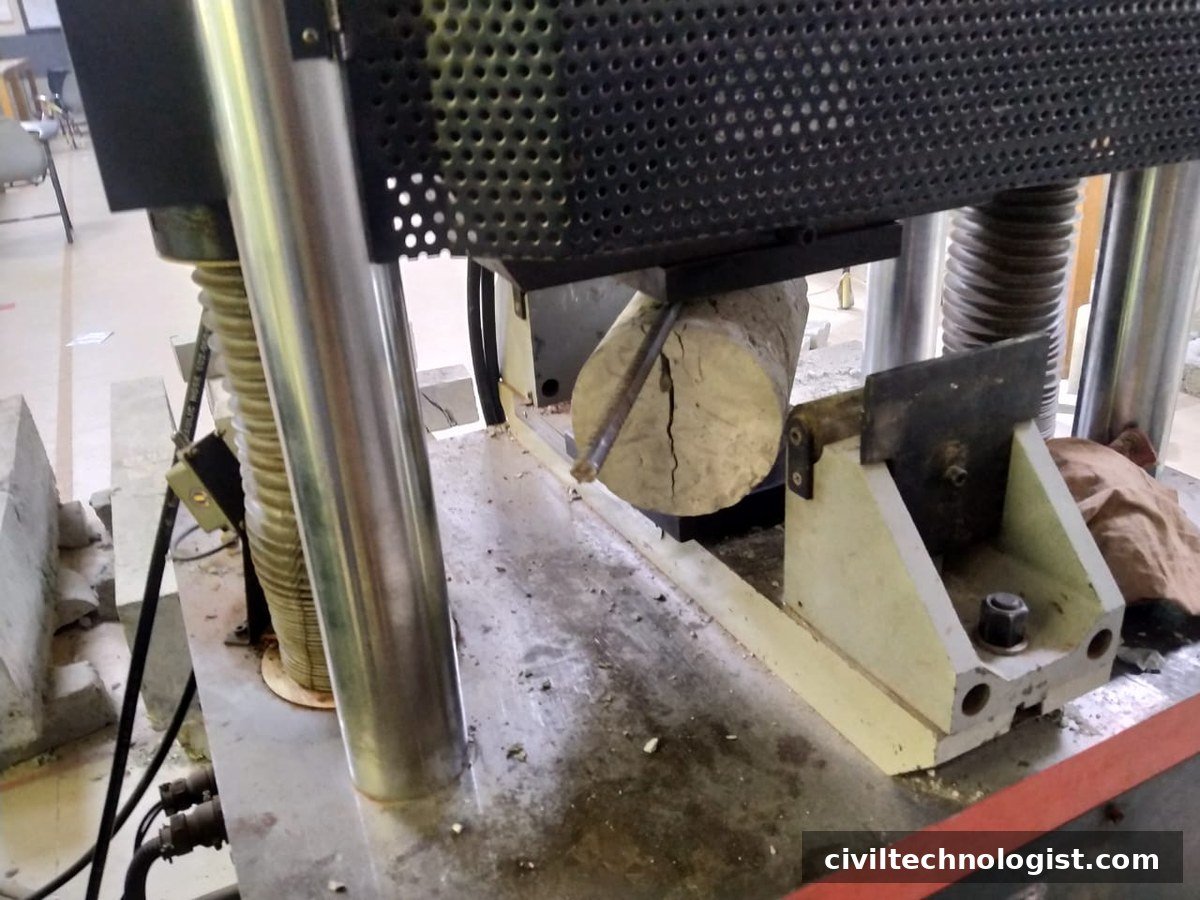
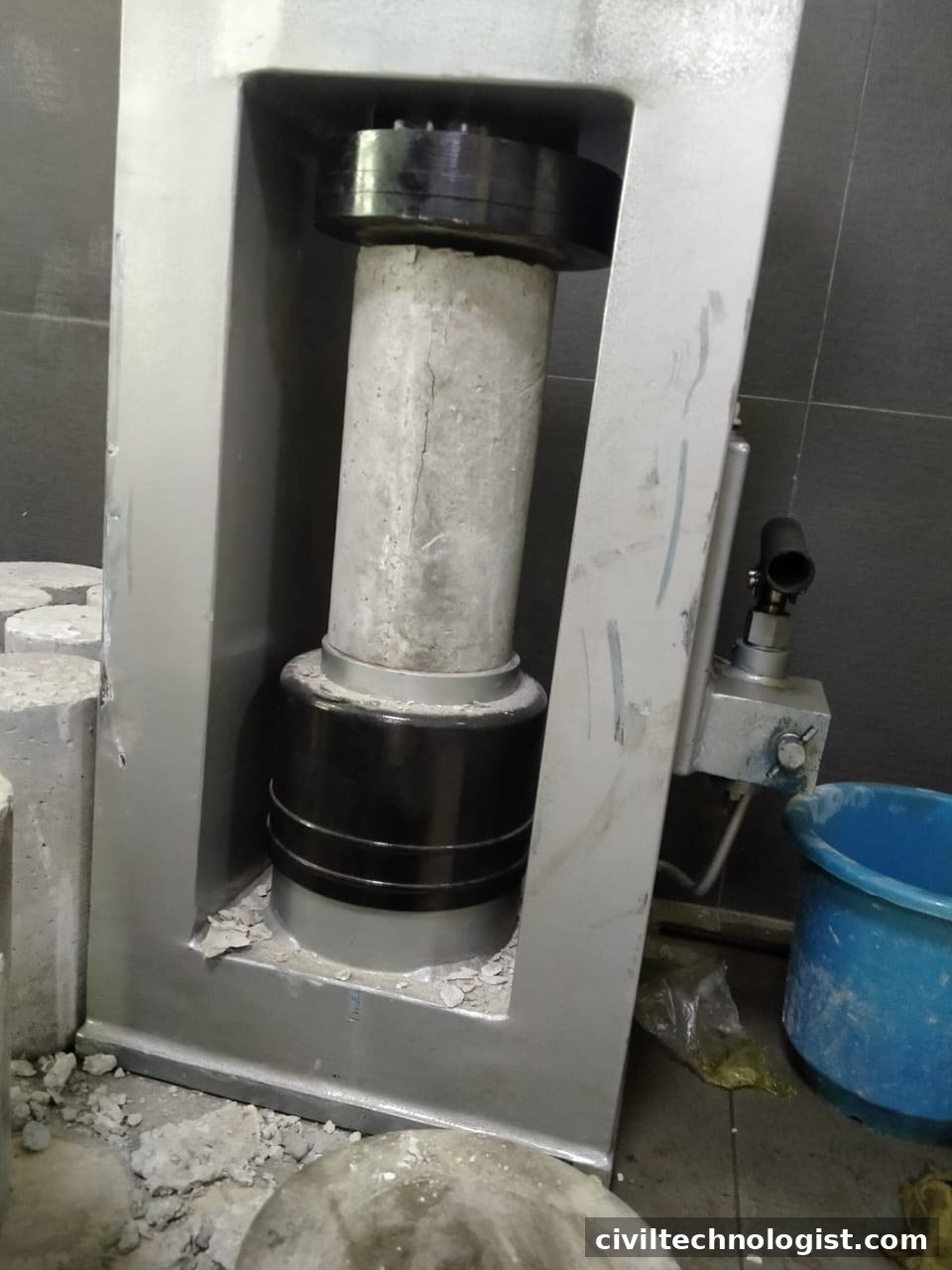
- Load in a calibrated compression machine at a steady rate — EN 12390 specifies 0.6 ± 0.2 MPa/s (N/mm²/s) — until the specimen fails. Record the maximum (failure) load P.
- Calculate strength from the formula below. Note the failure pattern too: a proper cone or cone-and-split break is normal; explosive or one-sided failures suggest bad capping or misaligned loading.
The Formula: f = P / A
Compressive strength is simply failure load divided by loaded cross-sectional area:
f = P ÷ A
where f is in MPa (N/mm²), P is the failure load in newtons, and A is the cross-sectional area in mm².
Worked Example 1 — 150 mm cube
- Failure load P = 850 kN = 850,000 N
- Area A = 150 × 150 = 22,500 mm²
- f = 850,000 ÷ 22,500 = 37.8 MPa (cube strength)
Worked Example 2 — 150 × 300 mm cylinder
- Failure load P = 610 kN = 610,000 N
- Area A = π/4 × 150² = 17,671 mm²
- f = 610,000 ÷ 17,671 = 34.5 MPa (cylinder strength)
Worked Example 3 — converting cube to equivalent cylinder
- Cube strength = 37.8 MPa (from Example 1)
- Equivalent cylinder = 0.80 × 37.8 = 30.2 MPa
This is how a lab result in cube-strength territory is checked against an f’c specified as cylinder strength.
Factors That Affect Compressive Strength
- Water–cement ratio — the dominant factor. Lower w/c means higher strength, up to the point where workability collapses.
- Curing — concrete gains strength only while it stays moist. Poor curing is the most common site-side cause of low breaks; see below.
- Age — strength grows fast early (roughly 65–70% of 28-day strength at 7 days for OPC concrete) and keeps creeping up for months.
- Compaction — honeycombed or poorly vibrated specimens test low because voids, not paste, carry nothing.
- Specimen shape and size — as above: cubes test higher than cylinders; smaller specimens test higher than larger ones.
- Loading rate — faster loading gives slightly higher apparent strength, which is why the rate is standardised.
- Cement quality and type — fineness, composition, and age of the cement all feed through; the cement test series covers how cement itself is checked.
Acceptance Criteria (ACI 318)
A single low result does not automatically condemn a pour. ACI 318 judges strength test results — each result being the average of at least two 150 × 300 mm cylinders (or three 100 × 200 mm cylinders) from the same batch:
- The average of any three consecutive strength test results must equal or exceed f’c.
- No individual strength test result may fall below f’c by more than 3.5 MPa (when f’c ≤ 35 MPa), or by more than 0.10 × f’c (when f’c > 35 MPa).
Worked acceptance check
Specified f’c = 30 MPa. Three consecutive results: 31.5, 30.2, 33.0 MPa.
- Average = (31.5 + 30.2 + 33.0) ÷ 3 = 31.6 MPa ≥ 30 MPa ✓
- Lowest single result = 30.2 MPa; limit = 30 − 3.5 = 26.5 MPa; 30.2 ≥ 26.5 ✓
- The concrete is accepted.
If results fail these checks, the code path is investigation — NDT, then cores (accepted if their average ≥ 85% of f’c with no single core below 75%) — and, if doubt remains, structural evaluation or strengthening.
The Role of Curing
Curing deserves its own emphasis because it is where site practice most often fails the lab’s promise. Cement hydration needs water and time: specimens cured continuously in water reach the strengths the mix was designed for, while concrete left to dry in sun and wind can lose 20–30% of its potential strength at the surface — exactly where durability matters most. Keep slabs and columns moist (ponding, wet hessian, curing compound) for at least 7 days for OPC concrete, longer for blended cements. When a 28-day break comes back low, the first question is always: was it cured?
Frequently Asked Questions
What is the formula for concrete compressive strength?
f = P/A — failure load in newtons divided by cross-sectional area in mm², giving strength in MPa (N/mm²).
Why is cylinder strength lower than cube strength?
Platen confinement affects the whole of a short cube but only the ends of a slender cylinder. The cylinder result is closer to true uniaxial strength; the conversion factor is about 0.80.
What loading rate is used in the compression test?
EN 12390 specifies 0.6 ± 0.2 MPa/s, applied steadily until failure.
What are the ACI 318 acceptance criteria?
Average of three consecutive tests ≥ f’c, and no single test below f’c − 3.5 MPa (for f’c ≤ 35 MPa) or below 0.90f’c (for f’c > 35 MPa).
What 7-day strength should I expect?
Roughly 65–70% of the 28-day strength for ordinary Portland cement concrete — a useful early warning, not an acceptance test.
What happens if concrete fails the strength test?
Investigate first (check curing, batching, testing procedure), then non-destructive testing, then drilled cores. Removal is the last resort, not the first response.
Final Thoughts
Compressive strength looks like one number, but it is really a chain: right mix, proper casting, honest curing, standardised testing, and statistical acceptance. Break any link and the number lies. Keep the chain intact — f = P/A will take care of the rest.
Written by Mohsin Raza Adil — BSc Civil Engineering Technologist (NTC-registered), Pakistan.

Mohsin Raza Adil
BSc Civil Engineering Technologist (NTC-registered), Pakistan. I write practical, field-tested guides on construction materials, soil testing and site engineering — the way it is actually done on site.


2 thoughts on “Compressive Strength of Concrete: Cube vs Cylinder Test, Formula & Acceptance Criteria”