Of all the cement tests, specific gravity is the quickest honesty check on a bag of cement. Fresh ordinary Portland cement has a specific gravity of about 3.15. When the number comes out noticeably lower, something is wrong — the cement may be adulterated with cheaper mineral additions, under-burnt, or weathered by moisture. It takes one flask, one balance, and about half an hour to find out.
Why This Test Matters
- Adulteration check. Fly ash, slag, limestone powder, and other extenders are lighter than clinker. Blending them into OPC drags the specific gravity down — the test catches it.
- Quality of burning. Under-burnt clinker has lower density than properly burnt clinker.
- Mix design. The absolute-volume method of concrete mix design divides the cement mass by (specific gravity × 1000) to get the volume cement occupies. Using 3.15 when the real value is 3.05 throws the yield off.
Governing Standards
- IS 4031 (Part 11): 1988 — “Methods of physical tests for hydraulic cement: Determination of density” (uses the Le Chatelier flask)
- ASTM C188 — “Standard Test Method for Density of Hydraulic Cement” (also uses the Le Chatelier flask; specific gravity = cement density ÷ density of water at 4 °C)
Why Kerosene, Not Water?
This is the detail beginners get wrong. Cement reacts with water — it starts hydrating the moment the two meet, and the reaction changes the volume you are trying to measure. So the test uses a liquid that does not react with cement: water-free kerosene (naphtha is also permitted). The kerosene simply gets displaced by the cement particles, and the displaced volume is the true volume of the cement.
Apparatus
- Le Chatelier flask (250 ml capacity, graduated 0–1 ml and 18–24 ml on the stem, 0.1 ml divisions)
- Balance accurate to 0.05 g or better
- Water-free kerosene
- Constant-temperature water bath (room temperature)
- About 60–64 g of cement (IS 4031 uses ~60 g; ASTM C188 uses ~64 g)
Procedure
- Dry the flask and fill it with kerosene to a point on the stem between the 0 and 1 ml marks.
- Dry the inside of the flask above the liquid level.
- Immerse the flask in the water bath at room temperature and let it stabilise; record the initial kerosene level (first reading).
- Introduce the weighed cement sample (about 60–64 g) carefully — no splashing, and no cement sticking to the flask walls above the liquid.
- Insert the stopper and roll the flask gently in an inclined position until no more air bubbles rise. Do not shake it violently.
- Return the flask to the water bath, let the temperature stabilise, and record the final kerosene level (second reading).
Practical note: Temperature is the silent killer of this test. Kerosene expands noticeably with heat, so both readings must be taken at the same temperature — IS 4031 requires variations to stay within ±0.2 °C. Take the readings only after they stop drifting.
Formula and Worked Example
Specific gravity = Mass of cement (g) ÷ Displaced volume (cm³)
Displaced volume = Final reading − Initial reading (1 ml = 1 cm³).
Worked example:
| Reading | Value |
|---|---|
| Mass of cement | 64.0 g |
| Initial kerosene level | 0.6 ml |
| Final kerosene level | 21.0 ml |
| Displaced volume | 21.0 − 0.6 = 20.4 cm³ |
Specific gravity = 64.0 ÷ 20.4 = 3.14
That is a normal result for fresh OPC — comfortably in the 3.10–3.15 band.
Interpreting the Result
| Specific gravity | What it suggests |
|---|---|
| 3.10 – 3.15 | Fresh, genuine OPC |
| 3.00 – 3.10 | Possibly blended cement (PPC with fly ash runs ~2.90–3.00) or slightly weathered stock — check the bag markings |
| Below 3.00 | Suspect adulteration, heavy mineral addition, under-burning, or moisture damage — investigate before use |
Practical note: A single low reading is a warning, not a conviction. Repeat the test, check the cement’s age and storage (cement stored in damp conditions gains weight from pre-hydration), and confirm what type of cement the bag claims to be — Portland pozzolana cement is legitimately lighter than OPC.
Specific Gravity of Common Cement Types
| Cement type | Typical specific gravity |
|---|---|
| Ordinary Portland Cement (OPC) | 3.10 – 3.15 |
| Portland Pozzolana Cement (PPC) | 2.90 – 3.00 |
| Portland Slag Cement (PSC) | ~2.90 |
| Rapid hardening cement | 3.10 – 3.15 |
Blended cements are lighter because fly ash (~2.2) and slag (~2.9) are lighter than clinker. That is precisely why the test must be read against the declared cement type — a 2.95 result is normal for PPC and alarming for OPC.
How Specific Gravity Is Used in Mix Design
The absolute-volume method (ACI 211 / IS 10262 approach) treats 1 m³ of concrete as the sum of the absolute volumes of its ingredients:
Absolute volume of cement = Mass of cement ÷ (Specific gravity × 1000)
For 400 kg of OPC at SG 3.15: 400 ÷ 3150 = 0.127 m³. If the cement actually tested at 2.95 but the designer assumed 3.15, the cement occupies 0.136 m³ instead of 0.127 m³ — nearly 9 litres of concrete yield unaccounted for per cubic metre. On large pours that error compounds into real quantity and cost differences, which is why the mix design value should come from a test, not from memory.
Common Mistakes
- Using ordinary kerosene with water in it. Even a little dissolved water reacts with cement and skews the volume. Use water-free kerosene.
- Trapped air bubbles. Bubbles read as extra cement volume and push the result down. Roll patiently until bubbling stops.
- Cement stuck above the liquid line. Any cement that never enters the kerosene is weighed but not measured — the result drops.
- Rushing the temperature soak. Taking the second reading before the flask reaches bath temperature is the most common lab error.
- Testing with water instead of kerosene — the classic student mistake; hydration invalidates everything.
Frequently Asked Questions
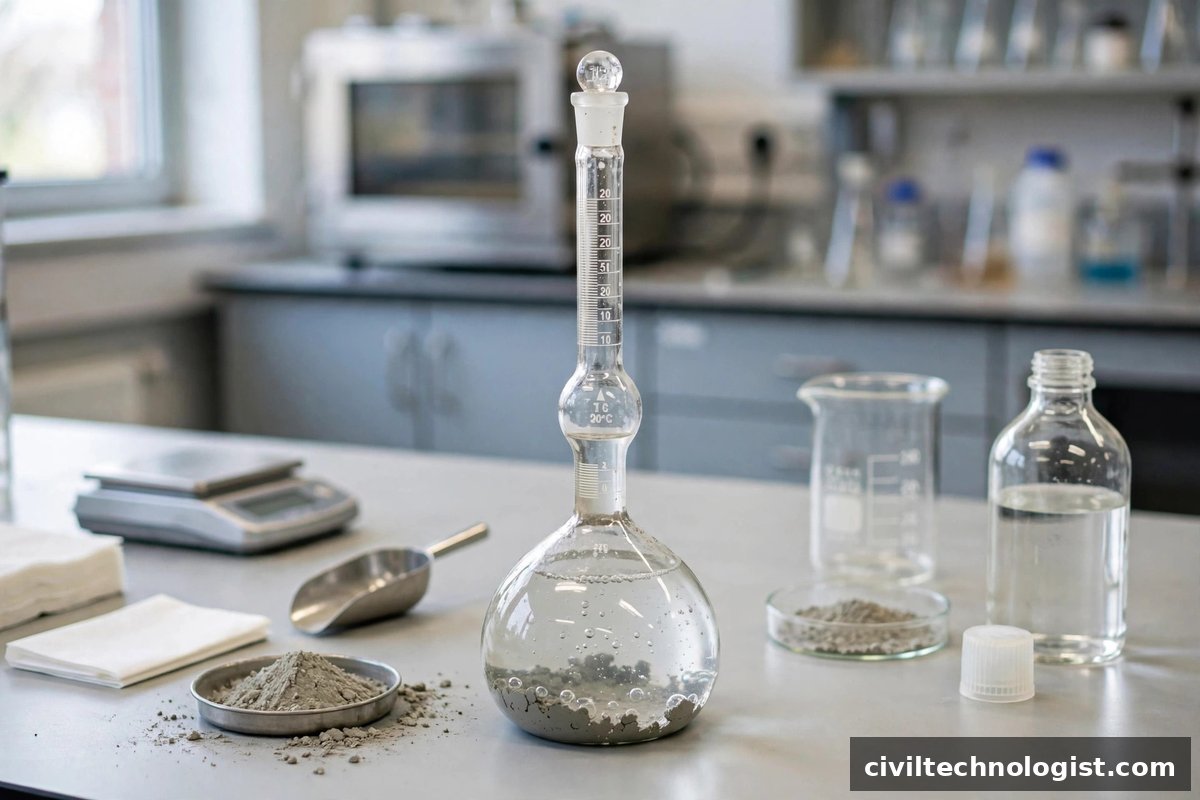
Le Chatelier flask test — the specific gravity of cement is found from the volume of kerosene displaced by a weighed cement sample
Why is the specific gravity of cement 3.15?
That is the density of well-burnt Portland cement clinker relative to water. It is a material property of the clinker minerals, which is exactly why deviations are informative.
Is PPC cement’s specific gravity lower?
Yes. Portland pozzolana cement, with its fly ash content, typically tests around 2.90–3.00. That is normal for PPC — the 3.15 expectation applies to OPC.
Can this test be done on site?
A site lab with a balance, a Le Chatelier flask, and kerosene can run it. It is one of the few cement acceptance tests practical outside a central lab, which is why consultants ask for it when a delivery looks suspicious.
Does specific gravity affect concrete strength directly?
Not directly — strength comes from the chemistry and fineness of the cement. But specific gravity is used in mix proportioning, and a wrong value changes the actual cement content per cubic metre of concrete.
Final Thoughts
Specific gravity will not tell you the strength of your cement, but it will tell you whether the bag contains what the label claims. For the cost of a flask of kerosene, it is the cheapest insurance on a cement delivery — run it whenever a new source or a suspicious batch arrives.
Written by Mohsin Raza Adil — BSc Civil Engineering Technologist (NTC-registered), Pakistan.

Mohsin Raza Adil
BSc Civil Engineering Technologist (NTC-registered), Pakistan. I write practical, field-tested guides on construction materials, soil testing and site engineering — the way it is actually done on site.
1 thought on “Specific Gravity of Cement Test (Le Chatelier Flask Method)”