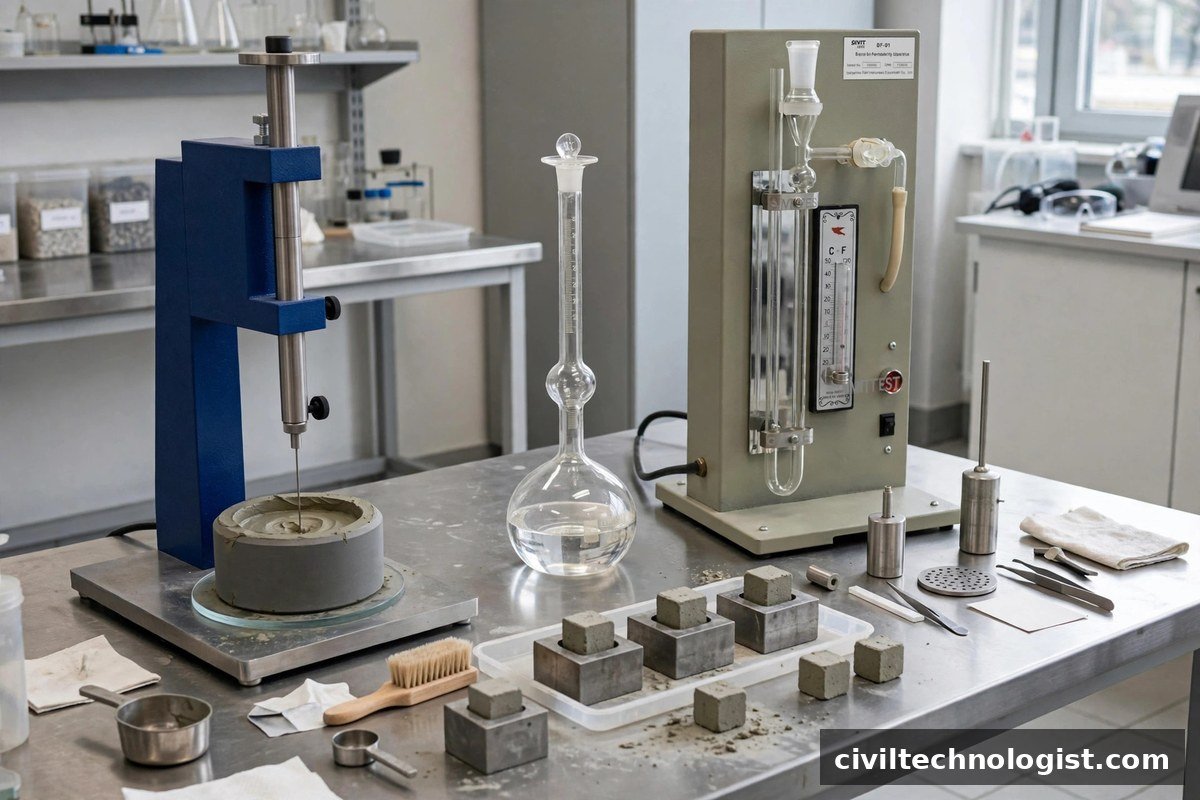
A bag of cement carries a lot of promises — strength, durability, predictable setting. These twelve tests are how those promises are checked: what each test measures, which standard governs it, and how it is done in brief. Keep this as a desk reference; each test below links to the ideas that matter on site.
1. Fineness Test (Dry Sieving)
Purpose: Checks that the cement is ground fine enough — finer cement hydrates faster and gains strength earlier.
Standard: IS 4031 (Part 2).
Method: Weigh 100 g of cement, sieve it on a 90-micron sieve for 15 minutes, and weigh the residue. For OPC, IS 269 limits the residue to 10% by mass. Sieving only catches coarse particles; for a true measure of fineness see the Blaine test below.
2. Blaine Fineness (Specific Surface)
Purpose: Measures fineness as total surface area per unit mass — the number that actually correlates with hydration rate and early strength.
Standard: ASTM C204; EN 196-6; air-permeability method described in IS 4031 (Part 2):1988.
Method: Air is drawn through a compacted bed of cement in the Blaine apparatus; the flow resistance gives the specific surface. IS 269 requires OPC to have a specific surface of not less than 225 m²/kg (2250 cm²/g).
3. Standard Consistency Test
Purpose: Finds the water percentage that gives a paste of standard plasticity — the reference water content for the setting-time and soundness tests.
Standard: IS 4031 (Part 4); ASTM C187; EN 196-3.
Method: Trial pastes at different water percentages are tested with the Vicat 10 mm plunger; consistency is the percentage at which penetration reaches 33–35 mm from the top of the mould (IS) or 10 ± 1 mm in 30 s (ASTM). Typical P for OPC: 26–33%.
4. Setting Time Test (Initial and Final)
Purpose: Confirms the cement does not set too fast to place (flash set) or so slowly that construction stalls.
Standard: IS 4031 (Part 5); ASTM C191; EN 196-3.
Method: Paste gauged at 0.85P is tested with the Vicat needle — initial set when the 1 mm needle stops penetrating to 5 mm from the bottom; final set with the annular attachment. IS 269 requires OPC initial set ≥ 30 minutes and final set ≤ 600 minutes.
5. Soundness Test
Purpose: Detects unsound cement — excess free lime or magnesia that causes expansion and cracking long after the concrete hardens.
Standard: IS 4031 (Part 3) — Le Chatelier method, expansion ≤ 10 mm; ASTM C151 — autoclave expansion ≤ 0.8%; EN 196-3.
Method (Le Chatelier): 0.85P paste is cast in a split brass cylinder with indicator arms; after boiling, the increase in distance between the arms is measured. Soundness failure is a rejection-level defect — unsound cement has no repair.
6. Compressive Strength Test
Purpose: The decisive acceptance test — verifies the cement actually delivers its grade (33, 43, or 53 MPa at 28 days).
Standard: IS 4031 (Part 6) — 1:3 cement-to-standard-sand mortar, 70.6 mm cubes, tested at 3, 7, and 28 days; EN 196-1 — 40 × 40 × 160 mm prisms; ASTM C109 — 50 mm (2-inch) cubes.
Method: Mortar cubes are cast, cured in water, and crushed in a compression testing machine; strength = failure load ÷ cross-sectional area.
7. Specific Gravity Test
Purpose: A quick honesty check on the bag — detects adulteration with lighter mineral additions, under-burning, or moisture damage.
Standard: IS 4031 (Part 11); ASTM C188 — both use the Le Chatelier flask.
Method: About 64 g of cement is added to water-free kerosene in the flask (water cannot be used — cement hydrates in it); specific gravity = mass ÷ displaced volume. Fresh OPC: ~3.15; PPC: ~2.90–3.00; much lower means investigate.
8. Heat of Hydration Test
Purpose: Measures the heat cement releases as it hydrates — critical for mass concrete (dams, rafts, thick footings), where trapped heat causes thermal cracking.
Standard: IS 4031 (Part 9); ASTM C186 — calorimeter methods.
Method: The heat evolved by hydrating cement is measured in a calorimeter at 7 and 28 days. Low-heat cement is limited to about 272 kJ/kg at 7 days and 314 kJ/kg at 28 days.
9. Chemical Composition Test
Purpose: Verifies the oxide chemistry — limits on magnesia, sulphur trioxide, alkalis, and chlorides that affect soundness, setting, and durability.
Standard: ASTM C114; IS 4032 — chemical analysis of hydraulic cement.
Method: Laboratory chemical analysis (gravimetric, volumetric, and instrumental methods) against the limits in the product standard (IS 269 / ASTM C150). This is a manufacturer/mill test, not a site test.
10. Loss on Ignition Test
Purpose: Detects pre-hydration, carbonation, or adulteration — fresh clinker loses little weight on heating; weathered or extended cement loses more.
Standard: ASTM C114; IS 4032.
Method: A weighed sample is ignited at high temperature and the percentage weight loss recorded. A rising loss-on-ignition in stored cement is a sign the stock is deteriorating.
11. Bulk Density Determination
Purpose: Gives the mass of cement per unit loose volume (~1440 kg/m³ for OPC) — needed for volume batching and for converting between mass and volume in mix computations.
Standard: No cement acceptance standard — this is a practical determination.
Method: Fill a container of known volume with cement (poured, not compacted, in a consistent manner), strike off level, and weigh. Report whether the value is loose or compacted — the two differ significantly.
12. Water Retention (Water Retentivity) Test
Purpose: Measures how well a mortar holds its mixing water against suction — important for masonry and plaster mortars laid on absorbent bricks and blocks, where rapid water loss kills workability and bond.
Standard: ASTM C1506 (water retention of hydraulic cement-based mortars); flow measured on the flow table per ASTM C1437.
Method: Mortar flow is measured before and after a controlled suction period; the retained flow percentage indicates water retentivity. Note this is a mortar property rather than a routine OPC acceptance test — it matters most for masonry cements and plaster work.
Quick-Reference Table
| # | Test | Governing standard | Key apparatus |
|---|---|---|---|
| 1 | Fineness (sieving) | IS 4031 Part 2 | 90-µm sieve |
| 2 | Blaine fineness | ASTM C204 / EN 196-6 | Blaine air-permeability apparatus |
| 3 | Consistency | IS 4031 Part 4 / ASTM C187 | Vicat apparatus, 10 mm plunger |
| 4 | Setting time | IS 4031 Part 5 / ASTM C191 | Vicat apparatus, 1 mm needle |
| 5 | Soundness | IS 4031 Part 3 / ASTM C151 | Le Chatelier apparatus / autoclave |
| 6 | Compressive strength | IS 4031 Part 6 / EN 196-1 / ASTM C109 | Compression testing machine |
| 7 | Specific gravity | IS 4031 Part 11 / ASTM C188 | Le Chatelier flask |
| 8 | Heat of hydration | IS 4031 Part 9 / ASTM C186 | Calorimeter |
| 9 | Chemical composition | ASTM C114 / IS 4032 | Chemistry lab |
| 10 | Loss on ignition | ASTM C114 / IS 4032 | Muffle furnace |
| 11 | Bulk density | Practical determination | Container of known volume |
| 12 | Water retention | ASTM C1506 | Flow table |
Frequently Asked Questions
Which cement tests are mandatory for site acceptance?
That depends on the specification, but the usual acceptance set is fineness, setting times, soundness, and compressive strength — with consistency run first because the others depend on it. Specific gravity is the common extra check when a delivery looks suspicious.
How often should cement be tested?
Per the project’s quality plan — typically each new source or lot, and whenever storage conditions or the cement’s appearance raise a doubt. Strength testing takes 28 days, so acceptance often proceeds on 3- and 7-day results with the 28-day test as confirmation.
Can these tests be done in a site lab?
Fineness, consistency, setting time, soundness, specific gravity, and bulk density are all feasible in a decent site lab. Strength needs proper curing and a calibrated CTM; chemical analysis and heat of hydration belong to central or manufacturer labs.
Final Thoughts
No single test describes cement — fineness without strength is meaningless, and strength without soundness is dangerous. Use this reference to ask for the right tests at the right time, and insist on seeing the numbers before a questionable batch goes into structural concrete.
Written by Mohsin Raza Adil — BSc Civil Engineering Technologist (NTC-registered), Pakistan.

Mohsin Raza Adil
BSc Civil Engineering Technologist (NTC-registered), Pakistan. I write practical, field-tested guides on construction materials, soil testing and site engineering — the way it is actually done on site.


2 thoughts on “12 Different Types of Cement Test: A Practical Reference”