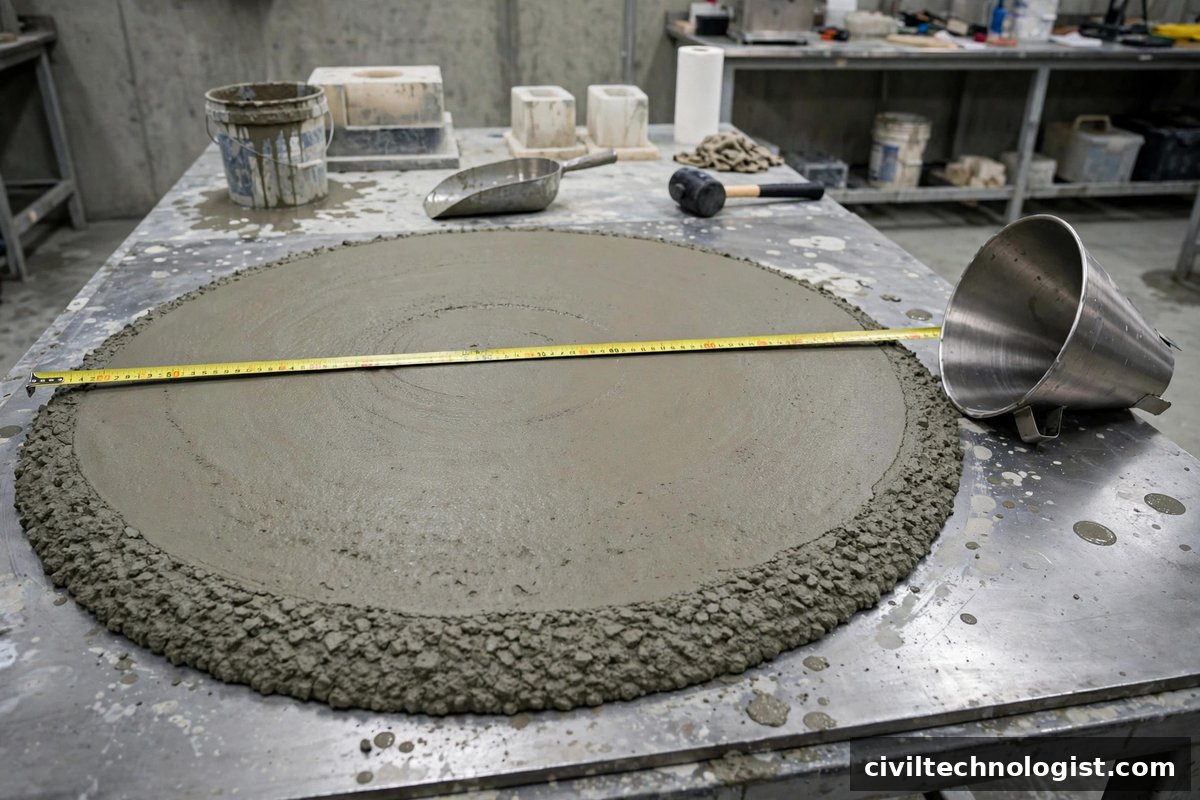
Watch any congested column being concreted on a Pakistani site and you will see the same struggle: a vibrator needle forced between dense bars, honeycombing discovered at de-shuttering, and a mason patching the damage with mortar. Self-compacting concrete was invented to make that scene unnecessary. It flows under its own weight, fills every corner of the formwork, wraps around dense reinforcement, and needs no vibration at all — while resisting segregation like a well-behaved conventional mix.
This guide explains what SCC is, how its mix design works, the fresh properties every batch must satisfy, where it is used, how it is quality-controlled, how it compares with conventional concrete, and its honest advantages and disadvantages.
What Is Self-Compacting Concrete?
Self-compacting concrete (SCC) — also called self-consolidating concrete — is a highly flowable, non-segregating concrete that spreads into place, fills formwork, and encapsulates reinforcement under its own weight, without any mechanical vibration.
It was developed in Japan in the late 1980s (pioneered by Professor Hajime Okamura at the University of Tokyo) as an answer to durability failures caused by poor compaction — structures were failing not because the mix design was wrong, but because vibrators never reached the concrete properly. The European guidelines most of the world works to today come from EFNARC (European Federation of National Associations Representing for Concrete), whose Specification and Guidelines for Self-Compacting Concrete defines the fresh-concrete requirements.
SCC uses the same basic ingredients as conventional concrete — cement, aggregates, water — but proportioned very differently, with powerful admixtures doing the work that the vibrator used to do.
The Three Fresh Properties of SCC
Every SCC mix must satisfy three functional requirements at the same time. This balance is the whole art of SCC:
- Filling ability — the concrete flows under its own weight and fills the formwork completely, including corners and edges, without vibration.
- Passing ability — the concrete flows through narrow gaps between reinforcement bars without the coarse aggregate getting blocked or jammed behind the bars.
- Segregation resistance — despite being highly fluid, the mix stays homogeneous: the coarse aggregate does not settle out and the paste does not separate from the aggregate during flow and placement.
A mix that flows beautifully but segregates is not SCC — it is just wet concrete, and it will produce weak, honeycombed work. All three properties must be verified by testing, not assumed.
Mix Design Principles
SCC mix design flips conventional proportions on their head:
- High powder content — cement plus mineral fillers such as fly ash, limestone powder, or ground granulated blast-furnace slag (GGBS). The extra fines give the paste the volume and viscosity needed to carry the aggregate without segregation.
- Less coarse aggregate — typically a lower coarse aggregate volume than conventional concrete, so the mix can pass through congested reinforcement.
- Smaller maximum aggregate size — generally limited to 20 mm; for heavily congested reinforcement, 10–12 mm.
- Low water–cement ratio — typically below 0.40 for high-performance SCC, though higher ratios are used with viscosity-modifying admixtures. Free water is generally kept below about 200 litres per cubic metre.
- High-range water reducer (superplasticizer) — polycarboxylate-based superplasticizers give the extreme fluidity without adding water.
- Viscosity-modifying admixture (VMA) — stabilises the mix and provides the segregation resistance that makes SCC different from merely “wet” concrete.
The water-to-powder ratio by volume is generally kept in the range of about 0.8 to 1.10. Because the balance is delicate, trial batches are mandatory — SCC is never designed on paper alone. Even small changes in aggregate moisture or fines content can push a passing mix into segregation.
Practical note: Water control on site is the make-or-break factor. A batching plant that is casual about aggregate moisture will produce SCC that varies from perfect to segregated within the same day. If you are supervising SCC, the moisture probes and the trial batch records deserve more of your attention than anything else.
Quality Control — The Four Standard Tests
Because SCC cannot be judged by the ordinary slump test (it would simply collapse), its workability is checked with a dedicated set of tests, standardised in the EN 12350 series:
| Test | Standard | What it measures | Typical target |
|---|---|---|---|
| Slump flow | EN 12350-8 | Filling ability — spread diameter of the concrete | 550–850 mm depending on class |
| V-funnel | EN 12350-9 | Viscosity and flow rate — time to empty a V-shaped funnel | A few seconds to ~25 s by class |
| L-box | EN 12350-10 | Passing ability — flow through a gate of bars | Blocking ratio ≥ 0.8 |
| J-ring | EN 12350-12 | Passing ability — spread with a ring of bars vs without | Small difference in spread |
Detailed procedures for each test are covered in the dedicated articles: slump flow test, V-funnel test, L-box test, and J-ring test.
EFNARC classes the slump flow roughly as: SF1 (550–650 mm) for unreinforced or lightly reinforced sections, SF2 (660–750 mm) for normal reinforced work, and SF3 (760–850 mm) for highly congested or complex formwork. Flow should normally be retained for at least 90 minutes so the concrete is still placeable when the truck arrives.
Applications of SCC
SCC earns its keep wherever conventional concrete struggles to be compacted properly:
- Heavily reinforced elements — columns, beams, shear walls, and beam-column joints where a vibrator needle physically cannot reach
- Deep or thin sections — walls and deep pours where vibration is impractical
- Precast concrete industry — faster casting cycles, better surface finish, no vibration noise in the plant
- Architectural / fair-face concrete — smooth, uniform surfaces with minimal bugholes
- Repairs and retrofitting — jacketing and narrow sections where access is limited
- Foundations and rafts with dense top and bottom mats — where two layers of heavy reinforcement make vibration nearly impossible
SCC vs Conventional Concrete
| Aspect | Conventional concrete | Self-compacting concrete |
|---|---|---|
| Compaction | Mechanical vibration required | None — flows under its own weight |
| Labour at placement | Vibrator operators plus placing crew | Smaller crew, no vibrator operators |
| Noise | High (vibrators) | Low — a genuine benefit on urban and night works |
| Placing speed | Limited by vibration cycle | Faster discharge and placement |
| Surface finish | Depends on vibration quality | Smoother, more uniform, fewer bugholes |
| Congested reinforcement | Difficult, honeycomb risk | Designed for it — flows through bars |
| Formwork pressure | Lower (partially vibrated in layers) | Higher — near-full liquid head; forms must be designed for it |
| Material cost | Lower | Higher (superplasticizer, VMA, fillers, more cement) |
| Quality control | Standard slump + cubes | Slump flow, V-funnel, L-box, J-ring + strict moisture control |
| Sensitivity to water variation | Moderate | High — small water changes cause segregation or loss of flow |
Advantages of Self-Compacting Concrete
- No vibration — eliminates vibrator noise, hand-arm vibration health risks for workers, and equipment wear
- Faster construction — quicker placement and shorter concreting programmes
- Better quality and durability — uniform compaction means fewer honeycombs, better bond with reinforcement, and lower permeability
- Excellent for congested reinforcement and complex shapes — reaches where a needle never could
- Superior surface finish — important for fair-face and precast work
- Less labour at the pour — smaller placing crew, no vibrator operators
- Lower pumping pressures — SCC generally pumps more easily over longer distances and heights than conventional concrete of the same strength
Disadvantages of Self-Compacting Concrete
- Higher material cost — superplasticizers, VMAs, and higher powder content make each cubic metre more expensive than conventional concrete (though placement savings often offset this)
- Demanding mix design — many trial batches and laboratory tests are needed before approval
- Strict quality control — aggregate moisture, fines content, and admixture dosing must be tightly controlled; site batching plants often struggle with this
- Higher formwork pressure — SCC behaves almost like a liquid, so formwork must be designed for near-hydrostatic pressure and be fully watertight, or it will leak paste and bulge
- Shrinkage sensitivity — the high paste content can increase early-age and drying shrinkage, so curing must be thorough and prompt
- Needs experienced production — plant and site staff need training; SCC punishes casual batching
Practical note: The most common SCC failure discussed on site is not the mix — it is the formwork. A form that holds conventional concrete perfectly well can leak grout or deflect under SCC’s liquid pressure. When SCC is used, the formwork design and the sealing of joints deserve a separate check, not an assumption.
Frequently Asked Questions
What is the main difference between SCC and conventional concrete?
SCC flows and compacts under its own weight without vibration, while conventional concrete must be mechanically vibrated to remove air voids. SCC achieves this with high powder content, superplasticizers, and viscosity-modifying admixtures.
Can the ordinary slump test be used for SCC?
No. SCC would give a collapse slump that tells you nothing useful. SCC workability is measured with the slump-flow, V-funnel, L-box, and J-ring tests.
Is SCC stronger than normal concrete?
At the same water–cement ratio, SCC is typically slightly stronger because the absence of vibration gives a better aggregate–paste interface and more uniform compaction. But strength is not its purpose — reliable compaction in difficult situations is.
Why is SCC more expensive?
The admixtures (superplasticizer, VMA), higher cement/filler content, and extensive trial batching and testing all add cost. The saving comes at placement: faster work, less labour, and fewer repairs.
Can water be added to SCC on site if it stiffens?
No — never add water to SCC on site. Extra water destroys the segregation resistance the mix was designed around. If flow is lost, the correct remedy is a re-dosing of superplasticizer by the supplier’s procedure, or rejection of the load.
Final Thoughts
Self-compacting concrete is not “expensive concrete” — it is insurance against the most common concreting failure there is: concrete that was never compacted properly. Where reinforcement is congested, sections are deep, or finish matters, it pays for itself in speed, quality, and repairs avoided. But it is unforgiving of sloppy batching and weak formwork. Specify it where its strengths matter, test every batch against the EFNARC criteria, and design the formwork for a liquid — and it will do exactly what its name promises.
Written by Mohsin Raza Adil — BSc Civil Engineering Technologist (NTC-registered), Pakistan.

Mohsin Raza Adil
BSc Civil Engineering Technologist (NTC-registered), Pakistan. I write practical, field-tested guides on construction materials, soil testing and site engineering — the way it is actually done on site.



1 thought on “Self-Compacting Concrete (SCC): Complete Guide”