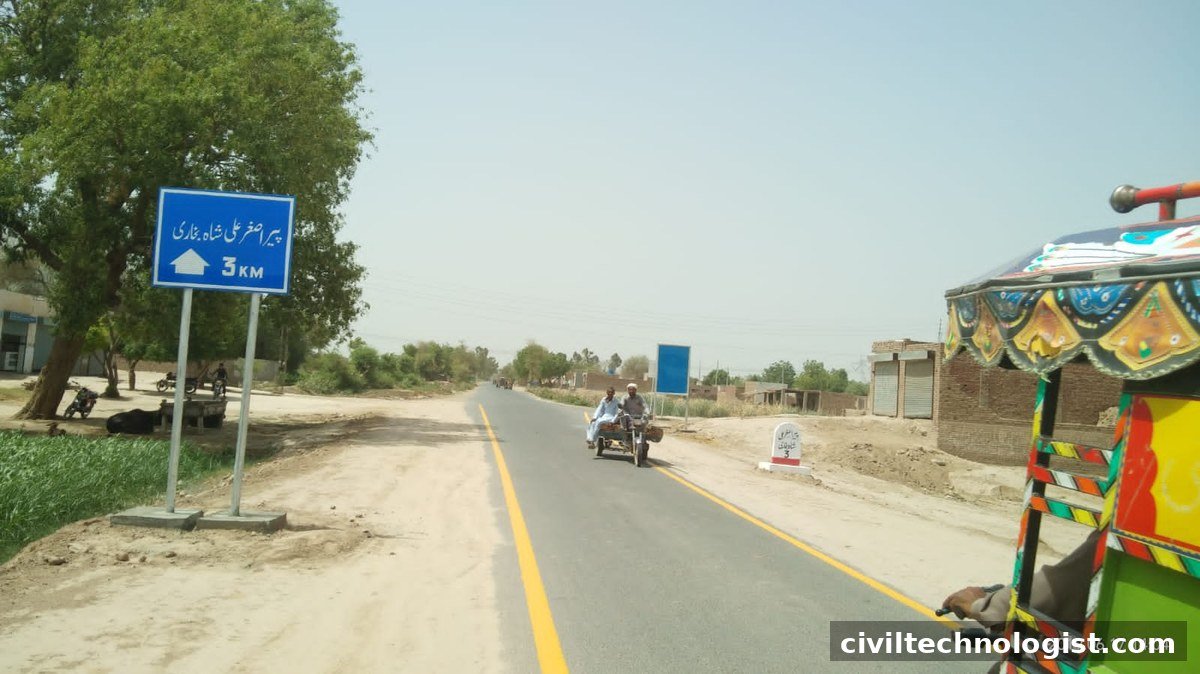
NHA Standards in Pakistan: Specifications & Key References
If you work on highways in Pakistan, one name appears on almost every contract document: NHA — the National Highway Authority. NHA is the federal agency responsible for the country’s national highways and motorways, and it publishes the specification book that governs how those roads are built: the NHA General Specifications.
This article explains what NHA standards Pakistan are, what they cover, how they relate to international standards like AASHTO, ASTM, and BS, and where engineers and contractors find them. Whether you are a site engineer checking a compaction report, a contractor pricing a tender, or a student learning highway specifications Pakistan for the first time, this guide gives you the working picture. A note of caution first: this is an overview and reference guide — it does not reproduce specification clauses. For any real project, the contract documents and the current edition of the NHA specification book govern, not this article.
Disclaimer: NHA specifications are revised periodically. Standard numbers, clauses, and limits mentioned here reflect publicly referenced practice; always check the current NHA specification book and your contract’s special provisions before quoting any requirement.
What Is the NHA?
The National Highway Authority is Pakistan’s federal highway agency, headquartered in Islamabad. It plans, builds, operates, and maintains the national highway and motorway network. When NHA awards a road or bridge contract, the technical rules of that contract come from its published specifications — most importantly the NHA General Specifications for road and bridge construction.
NHA was established in 1991 and today manages thousands of kilometres of national highways (the N-series routes) and motorways (the M-series routes). Because almost every federally funded road project in the country references NHA standards Pakistan, learning this one specification system prepares you for highway work anywhere in the country — from the Karakoram Highway rehabilitation to a motorway interchange in Punjab.
History of NHA: From Five Roads to a National Network
NHA did not appear overnight. Its story starts in 1978, when the Government of Pakistan federalised five important inter-provincial roads and named them National Highways. A National Highway Board was set up the same year to watch over the building and maintenance of those roads, which the provincial highway departments still executed.
That arrangement lasted thirteen years. In 1991, the National Highway Authority Act, 1991 (Act No. XI of 1991) was passed by Parliament, the National Highway Board was replaced, and the National Highway Authority was created as a statutory body under the Ministry of Communications, with its headquarters in Islamabad. From that day, the administration of national highways, motorways, expressways and strategic roads became NHA’s job.
NHA began in 1991 by taking over roads from the highway departments of all four provinces, with limited funds and a small staff. The motorway era then changed everything: the M-2 (Islamabad–Lahore) opened in 1997 as the first motorway in South Asia, and the network has grown ever since. NHA’s motto is “Friendly Highways”, its helpline is 130, and its official website is nha.gov.pk.
How NHA Is Organised
NHA is run under the National Highway Authority Act, 1991. At the top sits the National Highway Council, which approves five-year and perspective plans, national policies and guidelines, and the Authority’s annual budget. Below it, the Executive Board considers and approves schemes and recommends the larger projects to the government for approval.
The Chairman, NHA — appointed by the federal government — is the chief executive officer of the Authority and runs its day-to-day work from the head office in Islamabad. Working under the Chairman are the Members — Finance, Planning, Operations, Construction and Administration — each looking after a separate wing of the organisation.
For field work, NHA is divided into zones, each headed by a Member or a General Manager with regional offices: North Zone (Peshawar), Central Zone (Lahore), South Zone (Karachi) and West Zone (Quetta), along with separate Motorways zones (North and South). The zones are reorganised from time to time — for example, the Punjab Region has been split into South Punjab, North Punjab, Central Punjab and a separate Lahore Region — so always check the current structure on nha.gov.pk before quoting it.
What NHA Does: Functions and Duties
Under the Act, NHA’s purpose is stated in these words: “to plan, promote, organise and implement programmes for construction, development, operation, repairs and maintenance of national highways, motorways and strategic roads” specially entrusted to it by the federal government, a provincial government or another authority. In practice, that breaks down into:
- Planning — preparing a master plan for the development of national highways and roads, and five-year plans for construction, development, repair and maintenance.
- Building — constructing new highways, motorways, bridges, tunnels and expressways, and upgrading existing roads.
- Maintaining — routine, periodic and emergency maintenance of the whole network, so that roads stay safe and open.
- Operating — running the network day to day, including toll collection on national highways, motorways, expressways and strategic roads.
- Advising — advising the federal and provincial governments on matters relating to national highways and strategic roads.
- Setting standards — formulating policy and implementing regulations and standards for road construction and safety, including the NHA General Specifications and standard drawings.
- Research — carrying out surveys, experiments and technical research to improve the road network.
One fact every engineer should remember: NHA roads are only about 4.6% of Pakistan’s total road network, yet they carry around 80% of the country’s commercial traffic. That is why the specification limits in this article matter so much — a small defect on an NHA road is felt by the whole economy.
The NHA General Specifications
The NHA General Specifications is the standard specification book referenced in Pakistani highway contracts. Publicly available project documents (for example, Punjab road project design reports) cite the NHA “General Specifications” as the governing document for material specifications, with special provisions in each contract covering any deviation from it.
In practice, the specifications are organised by work item, in the same way as other highway specification books around the world. A typical road contract’s technical requirements cover, in broad groups:
- Earthwork — excavation, embankment construction, compaction requirements
- Sub-base and base courses — granular sub-base, aggregate base, water-bound macadam
- Bituminous works — prime coat, tack coat, asphalt base and wearing courses
- Concrete works and structures — bridges, culverts, retaining walls, drainage structures
- Drainage and protection works — side drains, cross-drainage, slope protection
- Road furniture — signs, markings, guardrails, kilometre posts
Each group sets out the materials allowed, the construction method, the testing required, and the acceptance limits. The contractor builds to these; the consultant’s site laboratory verifies compliance.
Typical NHA Standards Pakistan Values: Compaction, CBR and Aggregate Limits (Approximate)
The figures below are taken from NHA specification charts (NHA Specification 1998) and the NHA quality tests & limitations tables.
Engineers new to highway work always ask the same question: “what numbers does the specification actually demand?” The tables below give the typical values referenced in NHA-linked highway practice in Pakistan. Treat every figure here as typical/approximate — your contract’s special provisions and the current NHA book are the final authority.
Compaction requirements (percentage of maximum dry density, AASHTO T-180)
| Layer | Compaction (% of maximum dry density, AASHTO T-180) |
|---|---|
| Embankment below 75 cm | 90% |
| Embankment 30–75 cm | 93% |
| Embankment/subgrade top 30 cm | 95% |
| Granular sub-base | 98% |
| Aggregate base course | 100% |
| Asphalt base course | 97% |
| Asphalt wearing course | 97% |
Practical note: On site, the consultant’s laboratory runs the field density test (sand-cone, AASHTO T-191) and divides the field dry density by the laboratory maximum dry density. If a sub-base layer tests at 97.4% against a 98% requirement, the layer is rejected and re-compacted — there is no rounding up on NHA work.
Minimum CBR values (typical)
| Layer / material | Minimum CBR (soaked) |
|---|---|
| Embankment material | 5% |
| Subgrade | 7% |
| Granular sub-base | 50% |
| Aggregate base course | 80% |
Practical note: If the natural subgrade tests below about 7% CBR, the design usually calls for subgrade improvement — blending, stabilisation with lime or cement, or an extra capping layer — before pavement layers go down. This is one of the most common reasons highway projects in soft-soil areas carry a “subgrade improvement” item in the BOQ.
Aggregate quality limits for base and wearing courses (typical)
| Test | Granular sub-base | Aggregate base | Asphalt base | Asphalt wearing | Concrete |
|---|---|---|---|---|---|
| Los Angeles abrasion (max) | 50% | 40% | 40% | 30% | 40% |
| Soundness (max) | — | 12% | 12% | 12% | 12% |
| Sand equivalent (min) | 25% | 45% | 45% | 45% | 75% |
| Flat & elongated particles (max) | — | — | — | — | 15% (concrete coarse aggregate) |
Aggregate crushing value 30% (typical max) and aggregate impact value 30% (typical max). Clay lumps & friable particles 1% max (concrete). Fineness modulus of sand 2.3–3.1. Plasticity index: sub-base 6% max, base course LL 25% min with PI 6% max, wearing course 4% max.
Bitumen and asphalt (typical)
| Marshall mix criteria | Asphalt base course | Asphalt wearing course |
|---|---|---|
| Marshall stability | 2250 kg min | 1000 kg min |
| Flow | 8–14 (0.25 mm) | 8–14 (0.25 mm) |
| Air voids | 4–8% | 4–7% |
| VMA | 13% min | 13% min |
| Voids filled with asphalt | 55–65% | 65–75% |
| Loss of stability | 25 max | 20 max |
| Asphalt content | 3.0% min | 3.5% min |
| Compaction blows | 112 per side | 75 per side |
Penetration grades 60/70 (wearing course, hot regions) and 80/100 (cooler regions / base). Prime coat 0.65–1.75 litres/m². Tack coat 0.20–0.40 litres/m².
Concrete strengths (typical, as referenced in NHA-linked documents)
| Class | Min cement kg/m³ | Max aggregate mm | 28-day strength kg/cm² | psi | Slump mm | Max w/c ratio |
|---|---|---|---|---|---|---|
| A | 300 | 20 | 210 | 3000 | 25–75 | 0.58 |
| A1 | 300 | 20 | 210 | 3000 | 25–75 | 0.58 |
| A2 | 350 | 25 | 245 | 3500 | 100–150 | 0.58 |
| A3 | 400 | 38 | 280 | 4000 | 100–150 | 0.58 |
| B | 250 | 51 | 170 | 2500 | 25–75 | 0.65 |
| C | 275 | 38 | 210 | 3000 | 25–75 | 0.58 |
| D | 450 | 25 | 350 | 5000 | 50–100 | 0.40 |
| D1 | 450 | 25 | 350 | 5000 | 50–100 | 0.40 |
| D2 | 500 | 25 | 425 | 6000 | 50–100 | 0.40 |
| D3 | 550 | 25 | 500 | 7000 | 50–100 | 0.40 |
| Y | 400 | 13 | 210 | 3000 | 25–75 | 0.58 |
| LEAN | 175 | 51 | 100 | 1500 | — | — |
Testing frequency: 6 cylinders are taken from each 50 cubic metres of concrete.
Gradation Limits: What Size of Stone Goes in Each Layer
Every granular layer in an NHA road must follow a fixed gradation — the percentage of material passing each sieve size. If the gradation is wrong, the layer will not compact properly, no matter how good the rolling is. The tables below give the NHA gradation limits (percent passing by weight) for water bound macadam, granular sub-base, aggregate base course, asphalt base course and asphalt wearing course. A dash (—) means the source table leaves that cell blank — usually because the sieve is larger than the material’s maximum size, so 100% passes by definition.
Water bound macadam (WBM) gradation
| Sieve size | Grading A | Grading B | Grading C |
|---|---|---|---|
| 4 inch | 100 | — | — |
| 3½ inch | 99–100 | — | — |
| 3 inch | — | 100 | — |
| 2½ inch | 25–60 | 90–100 | 100 |
| 2 inch | — | 25–75 | 90–100 |
| 1½ inch | 0–15 | 0–15 | 35–70 |
| 1 inch | — | — | 0–15 |
| ¾ inch | 0–5 | 0–5 | 0–5 |
Granular sub-base gradation
| Sieve size | Grading A | Grading B |
|---|---|---|
| 2½ inch | 100 | — |
| 2 inch | 90–100 | 90–100 |
| 1 inch | 50–80 | 55–85 |
| 3/8 inch | — | 40–70 |
| No. 4 | 35–70 | 30–60 |
| No. 10 | — | 20–50 |
| No. 40 | — | 10–30 |
| No. 200 | 2–8 | 5–15 |
Aggregate base course gradation
| Sieve size | Grading A | Grading B |
|---|---|---|
| 2 inch | 100 | 100 |
| 1 inch | 70–95 | 75–95 |
| 3/8 inch | 30–65 | 40–75 |
| No. 4 | 25–55 | 30–60 |
| No. 10 | 15–40 | 20–45 |
| No. 40 | 8–20 | 12–25 |
| No. 200 | 2–8 | 5–10 |
Asphalt base course gradation
| Sieve size | Grading A | Grading B |
|---|---|---|
| 2 inch | 100 | — |
| 1½ inch | 90–100 | 100 |
| 1 inch | — | 75–90 |
| ¾ inch | 56–75 | 65–80 |
| 3/8 inch | — | 45–60 |
| No. 4 | 23–40 | 30–45 |
| No. 8 | 15–30 | 15–35 |
| No. 50 | 4–10 | 5–15 |
| No. 200 | 3–6 | 2–7 |
Asphalt wearing course gradation
| Sieve size | Grading A | Grading B |
|---|---|---|
| 1 inch | 100 | — |
| ¾ inch | 90–100 | 100 |
| ½ inch | — | 75–90 |
| 3/8 inch | 56–70 | 60–80 |
| No. 4 | 35–50 | 40–60 |
| No. 8 | 23–35 | 20–40 |
| No. 50 | 5–12 | 5–15 |
| No. 200 | 2–8 | 3–8 |
On site, gradation is checked by sieve analysis of a sample from the stockpile or the laid layer. If the sample falls outside these limits, the material is rejected or blended before it goes into the road. Our sieve analysis article explains the test procedure step by step.
Gradation of filler material (crushed stone screening)
| Sieve designation | Size (mm) | Percent passing by weight |
|---|---|---|
| 3/8 inch | 9.5 | 100 |
| No. 4 | 4.75 | 85–100 |
| No. 100 | 0.150 | 10–30 |
Fine Aggregate (Sand) Grading Limits
Sand for NHA concrete and mortar must meet this grading (percent passing by weight). The same limits apply to all concrete classes.
| Sieve | Size (mm) | Percent passing |
|---|---|---|
| 3/8 inch | 9.50 | 100 |
| No. 4 | 4.75 | 95–100 |
| No. 16 | 1.18 | 45–85 |
| No. 50 | 0.30 | 10–30 |
| No. 100 | 0.15 | 2–10 |
| No. 200 | 0.075 | 0–3 |
Fineness modulus of sand: 2.3 to 3.1. Coarse aggregate for concrete is graded by nominal maximum size (13 mm to 51 mm, depending on the concrete class) — see the coarse-aggregate table in the section after next.
AASHTO Soil Classification Chart
NHA classifies soils by the AASHTO system, which groups a soil by its grain size, liquid limit and plasticity index. The group tells you at a glance whether the soil will make a good subgrade or a bad one — A-1 to A-3 are excellent to good, A-4 to A-7 are fair to poor. The table below is the AASHTO classification used on NHA projects.
| Group | No. 10 passing | No. 40 passing | No. 200 passing | Liquid limit | Plasticity index | Group index (max) | Usual material |
|---|---|---|---|---|---|---|---|
| A-1-a | 50 max | 30 max | 15 max | — | 6 max | 0 | Stone fragments, gravel and sand |
| A-1-b | — | 50 max | 25 max | — | 6 max | 0 | Stone fragments, gravel and sand |
| A-3 | — | 51 min | 10 max | Non-plastic | Non-plastic | 0 | Fine sand |
| A-2-4 | — | — | 35 max | 40 max | 10 max | 0 | Silty or clayey gravel and sand |
| A-2-5 | — | — | 35 max | 41 min | 10 max | 0 | Silty or clayey gravel and sand |
| A-2-6 | — | — | 35 max | 40 max | 11 min | 4 | Silty or clayey gravel and sand |
| A-2-7 | — | — | 35 max | 41 min | 11 min | 4 | Silty or clayey gravel and sand |
| A-4 | — | — | 36 min | 40 max | 10 max | 8 | Mostly silty soils |
| A-5 | — | — | 36 min | 41 min | 10 max | 12 | Mostly silty soils |
| A-6 | — | — | 36 min | 40 max | 11 min | 16 | Mostly clayey soils |
| A-7-5 | — | — | 36 min | 41 min | 11 min | 20 | Mostly clayey soils |
| A-7-6 | — | — | 36 min | 41 min | 11 min | 20 | Mostly clayey soils |
Subgrade rating: A-1, A-2 and A-3 — excellent to good. A-4 to A-7 — fair to poor. Drainage: A-1-a excellent, A-1-b good, A-3 excellent, A-2-4 and A-2-5 good to fair, A-2-6 and A-2-7 fair to poor, A-4, A-5 and A-6 poor, A-7 very poor.
A-7-5 or A-7-6? If the plasticity index is less than or equal to the liquid limit minus 30 (PI ≤ LL − 30), the soil is A-7-5. If PI is greater than LL − 30, it is A-7-6.
Group index (GI) — a single number for how bad a soil is as a subgrade (0 is best, 20 is worst): GI = (F − 35) × [0.2 + 0.005 × (LL − 40)] + 0.01 × (F − 15) × (PI − 10), where F is the percentage passing the No. 200 sieve. Worked example from the NHA chart: a soil with F = 41%, LL = 31 and PI = 12 gives GI = (41 − 35) × [0.2 + 0.005 × (31 − 40)] + 0.01 × (41 − 15) × (12 − 10) = 6 × 0.155 + 0.52 = 1.45, so the soil is A-6 (1).
Embankment material: embankment soil must have a soaked CBR of at least 5%. Material is unsuitable for embankment if its soaked CBR is below 5% or if it classifies as A-6 or A-7. Subgrade swell must not exceed 0.3%.
Riprap and Stone Pitching
Where a road runs beside a river, a drain or a steep slope, the slope is protected with heavy stone — riprap or stone pitching. The stone must be sound, tough, durable and dense, and resistant to air and water. Tests required: apparent specific gravity 2.5 minimum, water absorption 6% maximum, Los Angeles abrasion 45% maximum (500 revolutions). Mortar ratio for riprap: 1:3.
Riprap (protection stone)
| Class | Stone weight | Grading rule | Layer thickness |
|---|---|---|---|
| Class A | 15 to 25 kg | 50% of weight more than 20 kg | 20 cm |
| Class B | 30 to 70 kg | 50% of weight more than 50 kg | 45 cm |
| Class C | 60 to 100 kg | 50% of weight more than 80 kg | 60 cm |
Stone pitching
| Class | Stone weight | Grading rule | Thickness | Used for |
|---|---|---|---|---|
| Class 1 (heavy) | 15 to 25 kg | 50% of weight more than 20 kg | 20 to 25 cm | Culvert or bridge ends and approaches, wadi diversions, protection for structures and revetment to slopes |
| Class 2 (lighter) | 10 to 15 kg | 50% of weight more than 12 kg | 15 to 20 cm | Ditches, berms and dykes |
Stone masonry ratio for pitching: 1:4. All material must be placed to the lines and levels shown on the drawings.
Steel Bar Weights (NHA Table)
The weight of plain or deformed bars is computed from the theoretical weight of plain round bars of the same nominal size. Our steel bar weight chart article covers this in detail, with lengths and piece weights.
| Bar size (mm) | Weight (kg/m) | Bar size (mm) | Weight (kg/m) |
|---|---|---|---|
| 6 | 0.222 | 20 | 2.466 |
| 8 | 0.395 | 22 | 2.984 |
| 10 | 0.616 | 25 | 3.853 |
| 12 | 0.888 | 32 | 6.313 |
| 13 | 1.042 | 35 | 7.553 |
| 16 | 1.578 | 40 | 9.865 |
Prestressing steel: high-tensile wire conforming to ASTM A-421 or AASHTO M-204; strand or wire rope conforming to ASTM A-416 or AASHTO M-203. High-tensile alloy bars are stress-relieved and cold-stretched to a minimum of 9,100 kg/cm², with minimum ultimate tensile strength 16,570 kg/cm², minimum yield strength 9,100 kg/cm² (0.7% extension method), minimum modulus of elasticity 1.75 × 10⁶ kg/cm², and minimum elongation 4% in 20 bar diameters.
Curing Concrete (NHA 401.3.8)
All newly placed concrete must be cured as specified, unless the Engineer directs otherwise. The curing method is one or more of: (1) water method, (2) curing compound method, (3) reinforced waterproof paper method (if required by the Engineer), (4) forms-in-place method, (5) steam method, (6) polyethylene sheeting method.
Los Angeles Abrasion: Recommended Maximum Values
The Los Angeles abrasion test (IS 2386 Part IV) measures how hard an aggregate is — steel balls are rotated with the sample in a drum, and the percentage worn away is the abrasion value. The lower the value, the harder the stone. Recommended maximum values by use:
| Use | Maximum abrasion value (%) |
|---|---|
| Water bound macadam sub-base course | 60 |
| WBM base course with bituminous surfacing | 50 |
| Bituminous bound macadam | 50 |
| WBM surfacing course | 40 |
| Bituminous penetration macadam | 40 |
| Bituminous surface dressing / cement concrete surface course | 35 |
| Bituminous concrete surface course | 30 |
Compare these with the NHA limits in the aggregate table above (LA abrasion 50% max for sub-base, 40% for base, 30% for wearing course) — the wearing course is always the strictest, because it takes the traffic directly.
Coarse Aggregate Grading for Concrete (by Concrete Class)
Coarse aggregate for NHA concrete is graded by the concrete class — each class has its own nominal maximum aggregate size, and the sieve limits follow from it. The table below gives the percent passing by weight for each class (A, A1, A2, A3, B, C, D, D1, D2, D3, Y and LEAN). A dash (—) means the NHA chart leaves that cell blank for that class.
| Sieve | A | A1 | A2 | A3 | B | C | D | D1 | D2 | D3 | Y | LEAN |
|---|---|---|---|---|---|---|---|---|---|---|---|---|
| 2½ inch (63.5 mm) | — | — | — | — | 100 | — | — | — | — | — | — | 100 |
| 2 inch (51 mm) | — | — | — | 100 | 95–100 | 100 | — | — | — | — | — | 95–100 |
| 1½ inch (38 mm) | — | — | 100 | 95–100 | — | 95–100 | 100 | 100 | 100 | 100 | — | — |
| 1 inch (25 mm) | 100 | 100 | 95–100 | — | 35–70 | — | 95–100 | 95–100 | 95–100 | 95–100 | — | 35–70 |
| ¾ inch (19.5 mm) | 90–100 | 90–100 | — | 35–70 | — | 35–70 | — | — | — | — | 100 | — |
| ½ inch (12.5 mm) | — | — | 25–60 | — | 10–30 | — | 25–60 | 25–60 | 25–60 | 25–60 | 90–100 | 10–30 |
| 3/8 inch (9.5/10 mm) | 20–55 | 20–55 | — | 10–30 | — | 10–30 | — | — | — | — | 40–70 | — |
| No. 4 (4.75 mm) | 0–10 | 0–10 | 0–10 | 0–5 | 0–5 | 0–5 | 0–10 | 0–10 | 0–10 | 0–10 | 0–5 | 0–5 |
How to read it: find your concrete class in the classes table above (for example, Class A3 uses 38 mm maximum aggregate), then read down that column. The fine aggregate (sand) grading in the section above applies to all classes alike.
Traffic Road Signs (NHA Item 607)
Road signs on NHA projects follow item 607 of the specification. The main parts and their requirements:
Metal posts (item 607.2.3, ASTM A 501): steel posts of minimum internal and external diameters of sixty-three (63) mm and seventy-five (75) mm. Tensile strength 400 MPa minimum (~58,000 psi), yield strength 250 MPa minimum (~36,000 psi), elongation in 2 inches 23% minimum. Wide flange (ASTM A 283, Grade D): tensile strength 415–550 MPa, yield strength 230 MPa minimum, elongation in 2 inches 23% minimum, elongation in 8 inches 20% minimum.
Sign panels (item 607.2.1): aluminium alloy conforming to ASTM B 209, alloy 5052-H38. Tensile strength 270 MPa minimum, yield strength 220 MPa minimum, elongation in 2 inches 4% minimum.
Nuts and bolts (item 607.2.5): heavily galvanised, 10 mm diameter, aluminium alloy galvanised according to ASTM A 153. Zinc coating 550 g/m² minimum, coating thickness 79 micron minimum.
Concrete foundation blocks (item 607.2.9): the concrete for the foundation blocks is in-situ Class A concrete, in accordance with item 401.1.1, of size 450 × 450 × 650 mm for category 1 and 2 signs, and 600 × 600 × 750 mm for category 3 signs.
Reflective sheeting (item 607-2, BSI 873 Part 6): minimum coefficient of retro-reflection (candelas per footcandle per square foot):
| Observation angle | Entrance angle | White | Yellow |
|---|---|---|---|
| 0.2° | −4° | 250 | 170 |
| 0.2° | 30°+ | 150 | 100 |
| 0.5° | −4° | 95 | 62 |
| 0.5° | 30°+ | 65 | 45 |
The brightness of the reflective sheeting when totally wet by rain must be at least ninety percent of the above values. The sheeting must be flexible enough to be applied over and to adhere to a moderately embossed surface, and must show no damage when bent at ninety degrees over a 50 mm diameter mandrel. It must show no cracking or reduction in reflection after a 25 mm diameter steel ball is dropped on it from a height of two metres. For heat-activated material, the adhesive must hold the sheeting securely forty-eight hours after application, at temperatures of up to ninety degrees Centigrade. The material must be weather-resistant: after cleaning it must show no definite fading, darkening, cracking, blistering or peeling, and must keep at least seventy-five percent of the specified wet or dry minimum brightness after five years of weathering.
Metal Beam Guard Rail (NHA Item 604.2, AASHTO M 180)
Guard rail on NHA roads is a W-beam steel rail on steel posts. The rail, its posts, its end sections and its bolts each have their own minimum strengths.
| Part | Requirement | Minimum value |
|---|---|---|
| Metal beam guard rail (item 604.2, AASHTO M 180) | Yield point | 3,500 kg/cm² |
| Tensile strength | 4,900 kg/cm² | |
| Elongation in 2 inches | 12% | |
| Connections and splices — all bolts and nuts (item 604.2.3, ASTM A 153) | Zinc coating | 550 g/m² |
| Coating thickness | 79 micron | |
| Guard rail posts (item 604.2.4, ASTM A-183) | Yield point | 250 MPa |
| Tensile strength | 400–550 MPa | |
| Elongation in 8 inches | 20% | |
| End or buffer sections (item 604.2.2) | Yield point | 227 MPa |
| Tensile strength | 310 MPa |
The bolted connection of the rail element to the post must withstand a pull of 2,270 kg at right angles to the line of the railing.
Bolts and nuts for guard rail (item 604.2.3, ASTM A 307)
| Property | Type A | Type B | Type C |
|---|---|---|---|
| Tensile strength (MPa), minimum | 415 | 415–690 | 400–550 |
| Yield point (MPa), minimum | — | — | 50 |
| Elongation in 2 inches (%), minimum | 18 | 18 | 23 |
All bolts and nuts are galvanised according to ASTM A 153: 305 g/m² where the thickness is above 9.52 mm, and 259 g/m² where it is under 9.52 mm.
Reflectorised Pavement Studs (Item 609.2)
The vertical load strength requirement for reflectorised pavement studs is 1,000 kg minimum.
Chain Link Fabric (Item 611.2.2, AASHTO M 181)
| Wire size | Zinc coating (g/m²) | Strength Type 1, 2 (kN) | Strength Type 3 (kN) | Strength Type 4 (kN) |
|---|---|---|---|---|
| 4.88 mm (6 gauge) | 122.1 | 9.650 | 6.940 | 9.655 |
| 3.76 mm (9 gauge) | 91.5 | 5.740 | 4.135 | 5.740 |
| 3.05 mm (11 gauge) | 91.5 | 3.780 | 2.715 | 3.780 |
Concrete posts for chain link fencing: Class D1. Steel posts: AASHTO M 183.
Deformed Billet-Steel Bars, Grades 40 and 60 (Item 404.2, AASHTO M-31 / ASTM A-615)
| Property | Grade 40 | Grade 60 |
|---|---|---|
| Yield strength (psi), minimum | 40,000 | 60,000 |
| Tensile strength (psi), minimum | 60,000 | 90,000 |
| Elongation (%), #3 (10 mm) bars | 11 | 9 |
| Elongation (%), #4, 5, 6 (13, 16, 19 mm) bars | 12 | 9 |
| Elongation (%), #7, 8 (22, 25 mm) bars | — | 8 |
| Elongation (%), #9, 10, 11, 14, 18 (29, 32, 36, 43, 57 mm) bars | — | 7 |
The Grade 40 elongation for #7 and larger bars is not given in the chart. Variation in unit weight: at least 94% of the nominal weight.
Cement for NHA Concrete (Item 401.2.1, ASTM C-150, OPC Type 1)
| Property | Limit |
|---|---|
| Air content by volume | 12% maximum |
| Fineness (m²/kg) | 160 minimum |
| Air permeability | 280 minimum |
| Autoclave expansion | 0.8 maximum |
| Compressive strength, 3 days | 1,740 psi |
| Compressive strength, 7 days | 2,760 psi |
| Setting time, initial | 45 minutes |
| Setting time, final | 375 minutes |
Grouting of bonded steel: one part cement to 0.75 part sand, water–cement ratio 0.45 maximum, strength 170 kg/cm² after 7 days.
Emulsified Asphalts (Item 301-5, AASHTO M-140)
| Test | RS-1 | RS-2 | SS-1 |
|---|---|---|---|
| Viscosity, Saybolt Furol at 25°F (seconds) | 20–100 | — | 20–100 |
| Viscosity, Saybolt Furol at 50°C (seconds) | — | 75–400 | — |
| Settlement, 5 days (%) | 5 max | 5 max | 5 max |
| Storage stability test, 1 day (%) | 1 max | 1 max | 1 max |
| Demulsibility, 35 ml 0.02 N CaCl₂ (%) | 60 min | 60 min | — |
| Cement mixing test (%) | — | — | 2 max |
| Sieve test (%) | 0.10 max | 0.10 max | 0.10 max |
| Residue by distillation (%) | 55 min | 63 min | 57 min |
| Penetration of residue, 25°C, 100 g, 5 sec | 100–200 | 100–200 | 100–200 |
| Ductility of residue, 25°C, 5 cm/min (cm) | 40 min | 40 min | 40 min |
| Solubility in trichloroethylene (%) | 97.5 min | 97.5 min | 97.5 min |
Elastomeric Bearing Pads and Deck Expansion Joint Seals
Elastomeric bearing pads (item 406.2.5):
| Test (ASTM) | Specification |
|---|---|
| Tensile strength (D 412) | 160 kg/cm² minimum |
| Elongation at break (D 412) | 350% minimum |
| Compression set, 22 hrs at 67°C (D 395 B) | 25% maximum |
| Tear strength (D 624, Die C) | 13 kg/cm² minimum |
| Hardness, Shore A (D 2240) | 60 ± 5 |
| Ozone resistance, 20% strain, 100 hrs at 38°C (D 1149) | No cracks |
| Low temperature stiffness, Young’s modulus at 35°C (D 797) | 350 kg/cm² maximum |
| Low temperature brittleness, 5 hrs at −40°C (D 736) | Passed |
Elastomer for deck expansion joint seals (item 406.2.3):
| Test (ASTM) | Specification |
|---|---|
| Hardness, Durometer A (D 2240) | 45 ± 5 points |
| Tensile strength (D 412) | 127 kg/cm² minimum |
| Elongation at break | 400% minimum |
| Compression set, 22 hrs at 70°C (D 395 B) | 20% maximum |
| Low temperature (D 746) | Not brittle at 40°C |
| Ozone resistance, 100 PPHM ozone for 70 hrs at 38°C (D 1149) | No cracks |
| Oil deterioration, volume increase after soaking in ASTM oil No. 3 for 70 hrs at 100°C (D 470) | 120% maximum |
Road Marking Paints (Item 608)
Road marking paint: 1 litre of paint covers 2.5 m² or less. Yellow paint thickness 0.8 mm, white paint thickness 1.5 mm, paint density 1.34 g/cc, glass beads 500 g per litre of paint.
Chlorinated rubber paint (item 608.2.1):
| Component | White | Yellow | Black |
|---|---|---|---|
| Pigment: titanium dioxide (rutile) and extenders / chrome yellow and extenders / chrome black and extenders | 100% | 100% | 100% |
| Modified chlorinated rubber, plasticised, and resin blend | 52 ± 4% | 52 ± 4% | 52 ± 4% |
| Solvents | 45 ± 4% | 45 ± 4% | 45 ± 4% |
| Additives | 1–3% | 1–3% | 1–3% |
| Pigments (by weight) | 55 ± 4% | 55 ± 4% | 55 ± 4% |
| Vehicle, solvent and additives (by weight) | 45 ± 5% | 45 ± 5% | 45 ± 5% |
Hot-applied thermoplastic road paints (item 608):
| Property | Limit |
|---|---|
| Binder (resin and oil) | 18–22% |
| Pigment | 6% minimum |
| Pigment and extender | 18–22% |
| Ballotini | 20% minimum |
| Aggregate pigment, extender and ballotini | 78–82% |
| Softening point (white and yellow) | 65°C minimum |
| Heat stability: white / yellow | 65 / 55 minimum |
| Flow: white / yellow | 25% maximum |
| Colour and luminance: white / yellow | 70 / 55 minimum |
| Ballotini (B) | 400–500 g/m² |
| Applied rate: paint / ballotini | 1–2.5 L/m² / 500 g/L minimum |
Ballotini (A) sieve retention: No. 12 — 0%, No. 20 — 30%, No. 30 — 50%, No. 50 — 80%, No. 80 — 100%.
Remember: these tables describe the kind of numbers NHA standards Pakistan work with. The governing numbers are always in your contract documents.
How NHA Specs Relate to AASHTO, ASTM, and BS
One thing that surprises newcomers: the NHA specifications do not reinvent every test. They reference international standards for materials and testing, which is why the same designations appear in Pakistani contract documents and in the test articles on this site:
- AASHTO — the American highway standards body. NHA bridge design commonly follows AASHTO LRFD bridge design specifications, and field tests like the sand-cone density test reference AASHTO T-191. Our field density test report format article covers exactly this test.
- ASTM — material standards: for example, reinforcing steel is commonly specified as ASTM A615 Grade 60 (60,000 psi yield), and concrete test methods follow ASTM procedures.
- BS / BS EN — British standards are still cited in Pakistani practice for some materials and tests, alongside the American standards.
Typical material requirements you will see referenced in NHA-linked project documents include concrete strengths of 4000 psi for bridge substructure, deck slabs, and culverts, 5000 psi for prestressed girders, and Grade 60 deformed reinforcement — but treat these as examples of the kind of requirements specified, not as universal values. The governing numbers are always in the contract.
The geometric side of highway design — alignment, superelevation, sight distance, cross-sections — likewise follows AASHTO guidelines, adapted to Pakistan’s highway practice.
How NHA Specs Connect to the Tests on This Site
Most of the laboratory and field tests we document exist because a specification demands them. The chain works like this:
Specification → required test → acceptance limit → site laboratory report.
Examples from this site:
- Compaction of earthwork and granular layers is verified by the field density test (AASHTO T-191 / ASTM D1556) — the sand-cone method, compared against the laboratory maximum dry density.
- Subgrade strength for pavement design is measured by the California Bearing Ratio (CBR) test.
- Aggregate quality for base courses is checked by sieve analysis and the crushing/impact value tests.
- Base course construction methods and materials are covered in our base course article.
When a consultant rejects a layer of sub-base, it is almost always because one of these tests came back outside the specification limit. Understanding the tests is understanding how the specification is enforced.
Worked Example: Verifying Sub-Base Compaction Under NHA Standards Pakistan
Here is how the numbers actually work on site. Suppose the laboratory Proctor test (AASHTO T-180) on the sub-base material gives:
- Maximum dry density (MDD) = 2.16 g/cm³
- Optimum moisture content (OMC) = 8.5%
The field crew compacts a trial layer, and the site laboratory runs a sand-cone test:
- Field dry density = 2.12 g/cm³
- Field moisture = 8.2% (close to OMC — good)
Step 1 — Calculate compaction:
Compaction % = (Field dry density ÷ MDD) × 100 = (2.12 ÷ 2.16) × 100 = 98.1%
Step 2 — Check against the NHA requirement:
Required for granular sub-base ≈ 98% → 98.1% ≥ 98% ✓ Accepted.
Step 3 — What if it had been 97.4%?
97.4% < 98% → Rejected. The layer gets scarified, watered to near OMC, re-rolled, and re-tested. On NHA work, the consultant does not “adjust” a failing result — the test is repeated on the re-compacted layer, and the contractor bears the cost of the rework.
Practical note: The usual testing frequency on highway projects is at least one density test per 1000 m² of compacted layer (or per the contract’s stated frequency). On a 7.3 m wide road, that works out roughly one test every 135–140 running metres per layer. Keep a running log — consultants ask for it at every IPC.
Field Tips: Applying NHA Standards Pakistan on Site
Theory is fine; here is how site engineers actually live with the specification book:
- Carry the relevant sections, not the whole book. Nobody reads 800 pages on site. Photocopy or save the clauses for your work item (earthwork, sub-base, asphalt) and keep them in the site office file. When the consultant’s inspector quotes a clause, you want the same page in front of you.
- Special provisions beat general specifications. If the contract’s special provisions say sub-base compaction is 100% instead of the book’s 98%, the special provisions win. Always read both — disputes are lost by engineers who read only one.
- Log every test against its clause. Write the specification reference (e.g. “NHA Gen. Specs, sub-base compaction 98%”) on the test request form. When a result is borderline, the clause number is what the discussion revolves around.
- Moisture is half the battle. Most failed compaction tests I have seen were not a rolling problem — they were a watering problem. Check moisture content before the roller starts, not after the test fails.
- Aggregate stockpiles get tested too. Don’t wait until the base course is laid to discover the crushing value is 34%. Test each new stockpile or quarry source before it goes into the works.
- Keep the edition current. Using a 2005 photocopy against a 2024 contract is a classic junior-engineer mistake. Confirm the edition stated in the contract documents.
Where to Find NHA Specifications
- NHA headquarters / regional offices (Islamabad) — the official source for the current specification books and standard drawings (NHA’s Central Design Cell issues standard drawings for bridges and structures).
- Tender / contract documents — every NHA tender includes the applicable specifications and the project’s special provisions. For a contractor, this is the working copy that matters.
- Consultant and contractor libraries — firms working regularly on NHA projects keep reference copies; always confirm the edition matches the contract.
If you are a student or a young engineer, the most practical approach is to read the specifications alongside the tests: pick one work item (say, granular sub-base), read what the specification requires, then read the corresponding test procedure. That pairing is how site engineers actually learn the system.
NHA Road Network: Motorways and National Highways
NHA looks after two main kinds of road, and a site engineer should know which one a project belongs to — because the design standard, the traffic and the maintenance arrangement all follow from it.
Motorways (the M-routes) are access-controlled, high-speed roads built for long-distance travel between cities. You can only join or leave a motorway at an interchange — there is no direct access from fields, houses or side roads, and slow-moving traffic is not allowed.
National highways (the N-routes) are the older trunk roads that link cities, towns, ports and border crossings. They are open-access roads: they pass through towns and villages and carry mixed traffic — trucks, buses, cars, tractors and motorcycles side by side.
Both are built and maintained by NHA, but motorways are designed to higher geometric standards than national highways, which is why their design speeds, lane widths and safety features are more generous.
NHA network in numbers
According to the Pakistan Economic Survey 2024-25, NHA is the custodian of 48 national highways, motorways and strategic roads with a total length of 14,480 kilometres, spread across 118 of Pakistan’s 160 districts. Pakistan’s total road network is about 264,000 km — so NHA manages roughly 4.6% of the country’s roads, while carrying about 80% of its commercial traffic.
| Province / Region | NHA road length | Districts covered |
|---|---|---|
| Punjab | 4,080 km | 30 of 36 |
| Sindh | 2,566 km | 26 of 35 |
| Khyber Pakhtunkhwa | 2,392 km | 25 |
| Balochistan | 4,443 km | 27 |
| Gilgit-Baltistan | 854 km | — |
| Azad Jammu & Kashmir | — | 3 |
| Islamabad Capital Territory | 54 km | — |
Balochistan has the longest NHA length of any province, even though its traffic is the lightest — a reminder that NHA’s job is connectivity, not just carrying traffic.
Motorways of Pakistan
Pakistan has 16 motorways on the map, of which 10 are fully operational; the rest are under construction or planned. More than 2,800 km of motorway is operational today. All motorways carry the prefix “M” followed by a number.
| Motorway | Route | Length (approx.) | Lanes | Opened | Status |
|---|---|---|---|---|---|
| M-1 | Peshawar – Islamabad | 155 km | 6 | 2007 | Operational |
| M-2 | Islamabad – Lahore | 375 km | 6 | 1997 | Operational |
| M-3 | Lahore – Abdul Hakeem | 230 km | 6 | 2019 | Operational |
| M-4 | Pindi Bhattian – Faisalabad – Multan | 309 km | 4–6 | 2019 | Operational |
| M-5 | Multan – Sukkur | 392 km | 6 | 2019 | Operational |
| M-6 | Sukkur – Hyderabad | 306 km | 6 | — | Under construction |
| M-9 | Hyderabad – Karachi | 136 km | 6 | 2018 | Operational |
| M-14 | Islamabad (Hakla) – Dera Ismail Khan | 285 km | 4 | 2022 | Operational |
Notes: M-2 was Pakistan’s first motorway and the first in South Asia; it is also quoted as 367 km in some sources — lengths differ slightly between sources because of link roads and measurement points. Other operational motorways include the M-8 (Ratodero–Gwadar), M-11 (Lahore–Sialkot) and M-15 (Hazara Motorway, Hassan Abdal–Thakot), all completed around 2020–2022. When M-6 (Sukkur–Hyderabad) is finished, the Karachi–Peshawar motorway corridor will be complete from end to end.
Major national highways
The best-known national highways, and the corridors they serve:
| Highway | Corridor | Known as |
|---|---|---|
| N-5 | Karachi – Lahore – Peshawar – Torkham | Grand Trunk (GT) Road |
| N-25 | Karachi – Quetta – Chaman | RCD Highway |
| N-35 | Hassan Abdal – Mansehra – Khunjerab | Karakoram Highway (KKH) |
| N-40 | Quetta – Noshki – Taftan | — |
| N-50 | Dera Ismail Khan – Zhob – Kuchlak | — |
| N-55 | Karachi – Dera Ghazi Khan – Peshawar | Indus Highway |
| N-65 | Sukkur – Sibi – Quetta | — |
| N-70 | Multan – Dera Ghazi Khan – Qila Saifullah | — |
| N-75 | Islamabad – Murree – Kohala | Murree Road |
| N-80 | Tarnol – Fateh Jang – Kohat | — |
N-5 is the backbone of the whole system — the historic Grand Trunk Road, carrying the heaviest traffic in the country. N-35, the Karakoram Highway, is the highest paved international road in the world and Pakistan’s link to China under CPEC.
NHA Design Standards: Geometry, Pavement and Axle Loads
NHA design standards set the shape of the road, the strength of its pavement and the loads it is allowed to carry. Three parts matter most on site.
Geometric design
Geometric design fixes the alignment, curves, gradients, sight distance and cross-section of the road. Motorways are designed for a design speed of 120 km/h, while national highways are designed for lower speeds suited to their terrain and traffic. A standard traffic lane is 3.65 m wide, with paved shoulders outside the traffic lanes so that a vehicle can stop safely in an emergency. As noted above, the geometric rules follow AASHTO guidelines, adapted to conditions in Pakistan.
Pavement design
Pavement design decides how thick each layer must be — subgrade, sub-base, base course and asphalt wearing course — so the road can carry its expected traffic over its design life. The key inputs are the strength of the subgrade, measured by the CBR test, and the traffic the road will carry, counted in equivalent standard axles. Most NHA roads use flexible (asphalt) pavements; concrete pavements are used in special places such as toll plazas and other heavily loaded spots. A pavement designed for light traffic will fail early under heavy trucks, which is why the traffic survey comes before the pavement design, not after it.
Axle load limits
No pavement survives overloading. That is why NHA enforces legal axle load limits on national highways and motorways, checked at weigh stations along the network. The limit depends on the axle arrangement — single, tandem and tridem axles each have their own limit — and an overloaded vehicle is fined and its excess load offloaded before it is allowed to continue. The limits in force are published in the current NHA notification, so always check the current one rather than relying on memory.
NHA Maintenance Standards: Routine, Periodic and Emergency Maintenance
Building a road is only half the job — keeping it in good condition is the other half. NHA maintenance falls into three types, and each has a different purpose and rhythm.
Routine maintenance
Routine maintenance is the everyday, year-round work: patching potholes, repairing edge breaks, cleaning drains and culverts, cutting grass and clearing vegetation, and cleaning or replacing signs and road markings. It is usually done by maintenance contractors working under NHA supervision. The idea is simple — fix small defects quickly, before they grow into expensive failures.
Periodic maintenance
Periodic maintenance is planned work carried out at intervals of several years, decided by condition surveys of the road. It includes resealing or surface dressing, thin asphalt overlays and full resurfacing of the wearing course, and strengthening of weak stretches. A road that receives its periodic treatment on time lasts far longer than one that is left until it fails.
Emergency maintenance
Emergency maintenance follows floods, heavy rain, landslides or accidents. It covers clearing debris, restoring washed-out sections, providing temporary diversions and repairing damaged bridges and culverts. Here speed matters most: the road must be made safe and reopened as quickly as possible, with permanent repairs following later.
On tolled routes, the toll collected from road users helps pay for this maintenance — which is one more reason toll plazas and weigh stations are part of the NHA system, not an afterthought.
Common NHA Specifications a Site Engineer Must Know
You do not need the whole specification book in your head, but a site engineer on an NHA project should know these documents and where to find them:
- NHA General Specifications — the main specification book. Know the clauses for the items you are building this week, and the testing and acceptance limits that go with them.
- NHA standard drawings — the standard details for culverts, bridges, drains and road furniture issued by NHA. Always work from the drawing issued with your contract, not an old copy.
- Special provisions — the project-specific additions and changes in your contract. Where they differ from the General Specifications, the special provisions govern.
- AASHTO and ASTM test methods — the test procedures named in the specification, such as the field density test, CBR test, sieve analysis and Marshall mix design.
- Testing frequencies — how often each test must be done, for example one density test per 1000 m² of compacted layer, as in the worked example above.
- Measurement and payment clauses — how each item is measured and paid, whether by cubic metre, square metre, tonne or number. This is the basis of every interim payment certificate (IPC).
- Material approval — materials and their sources must be approved before use. Work built with unapproved material can be rejected and is not paid for.
A site engineer who can find the right clause, the right drawing and the right test frequency without delay rarely gets surprised on an NHA project.
Removing Formwork: Minimum Periods
| Item | Minimum period before removal |
|---|---|
| Arch center | 14 days |
| Centering under beams | 14 days |
| Support under flat slabs | 14 days |
| Floor slabs | 14 days |
| Vertical wall surfaces | 24 hours |
| Columns | 24 hours |
| Girders | 24 hours |
| Sides of beams | 12 hours |
| Top slabs of R.C. box culverts | 14 days |
Note: the source chart prints “14 hours” for top slabs of R.C. box culverts, which looks like a typo — all other slab items are 14 days.
Brick Masonry (NHA Item 410)
Standard size 9″ × 4½” × 3″ (22.86 × 11.43 × 7.62 cm); well burnt, uniform colour, regular shape, sharp square corners and parallel faces; soaking time 1 hour; water absorption not more than 16.5% (one NHA chart lists 16.7% — a small difference between the two source documents); compressive strength 140.62 kg/cm² (2000 psi); curing at least 7 days after laying; mortar ratio 1:3.
Bituminous Surface Treatment Quantities (Table 304-1)
| Treatment | Aggregate kg/m² | Bitumen litres/m² |
|---|---|---|
| Single | 12.5 | 1.19–1.63 |
| Double, first application | 24.0 | 1.90–2.14 |
| Double, second application | 12.5 | 1.19–1.63 |
| Triple, first application | 24.0 | 1.90–2.14 |
| Triple, second application | 12.5 | 1.19–1.63 |
| Triple, third application | 6.5 | 0.68 |
| Seal coat / pad coat with aggregate | 4 | 0.5 |
Note: bitumen quantities may be varied by the engineer by ±15% depending on site conditions.
Toll, Patrolling and Road Safety
NHA collects toll on national highways, motorways, expressways and strategic roads. On tolled routes, the toll collected from road users helps pay for maintenance — which is one more reason toll plazas and weigh stations are part of the NHA system, not an afterthought.
Motorways are patrolled by the National Highways and Motorway Police (NHMP), who enforce speed limits, lane discipline and axle-load rules. If you break down or need help on a motorway, NHA’s helpline is 130.
Overloading is the single biggest enemy of pavement life. That is why NHA enforces legal axle load limits at weigh stations on national highways and motorways — single, tandem and tridem axles each have their own limit — and an overloaded vehicle is fined and its excess load offloaded before it is allowed to continue. The limits in force are published in the current NHA notification, so always check the current one rather than relying on memory.
Working With NHA: Tenders and Contracts
For engineers and contractors, NHA is one of the biggest clients in Pakistan. A few things to know before you bid or join a project:
- Tenders: NHA invites tenders for works and consultancy services, now through e-bidding. Notices appear on nha.gov.pk and in the press, and bidding follows public procurement (PPRA) rules.
- Registration: contractors and consultants working on NHA projects must be registered with the Pakistan Engineering Council (PEC) — firms as well as the engineers signing the work.
- The contract documents: every NHA tender includes the applicable specifications and the project’s special provisions. The NHA General Specifications are the standard rule book; the special provisions are the project-specific additions — and where the two conflict, the special provisions govern.
- Payment: work is measured and paid under the contract’s measurement and payment clauses — by cubic metre, square metre, tonne or number — through interim payment certificates (IPCs) based on measured work and test results.
- Quality: materials and their sources must be approved before use, and every layer is tested against the specification limits in this article. Work built with unapproved material can be rejected and is not paid for.
For a young engineer, the fastest way into NHA work is through a contractor or consultant already executing NHA projects — as a site engineer, lab technician or quantity surveyor — and learning the specification book on a live project.
Frequently Asked Questions
What does NHA stand for?
National Highway Authority — Pakistan’s federal agency for national highways and motorways, headquartered in Islamabad.
What are the NHA General Specifications?
The standard specification book for road and bridge construction referenced in NHA contracts in Pakistan. It sets out materials, construction methods, testing, and acceptance criteria, with project-specific special provisions covering deviations.
Do NHA specifications use AASHTO and ASTM standards?
Yes. NHA practice references AASHTO (e.g. AASHTO LRFD for bridge design, AASHTO test methods), ASTM (materials and test methods), and BS/BS EN standards rather than defining every test from scratch.
Where can I get a copy of NHA specifications?
From NHA offices in Islamabad or through the tender/contract documents of an NHA project, which always include the applicable specifications and special provisions.
Are NHA specifications the same as the tests on this website?
They are connected: the specifications require the tests. Our test articles (field density, CBR, sieve analysis, and others) document the procedures the specifications call up. The specification sets the limit; the test produces the number that is checked against it.
What compaction does NHA require for sub-base and base course in Pakistan?
Typically 98% of maximum dry density (AASHTO T-180) for granular sub-base and 100% for aggregate base course, verified by the sand-cone field density test (AASHTO T-191). These are typical values under NHA standards Pakistan — confirm the exact figure in your contract’s special provisions.
What is the minimum CBR value required by NHA standards Pakistan for subgrade?
Typically 7% (soaked CBR) for subgrade soil, 50% for granular sub-base, and 80% for aggregate base course.
Which bitumen grade is used in NHA road projects in Pakistan?
Penetration grade 60/70 is typical for wearing courses in hot regions, with 80/100 used in cooler areas or base courses. The exact grade, along with Marshall mix design criteria, is fixed in the contract documents.
What is the difference between the NHA General Specifications and special provisions?
The General Specifications are the standard rule book applying to all NHA work. Special provisions are project-specific additions or modifications written into an individual contract — and where the two conflict, the special provisions govern.
Do NHA standards Pakistan follow AASHTO or British standards?
Both, in practice. NHA specification are built around AASHTO (design guides, LRFD for bridges, test methods) and ASTM (materials), while BS/BS EN references still appear for certain materials and tests. The specification book tells you which standard applies to each item.
What concrete strength does NHA specify for bridges?
Typically 4000 psi for bridge substructure, deck slabs, and culverts, and 5000 psi for prestressed girders, with Grade 60 (ASTM A615) reinforcement. Treat these as typical values — the structural drawings and special provisions govern each project.
What is the difference between a motorway and a national highway in Pakistan?
A motorway is an access-controlled, high-speed road — you can only join or leave it at an interchange, and slow-moving traffic is not allowed. A national highway is an open-access trunk road that passes through towns and villages and carries all kinds of traffic. Both are built and maintained by NHA, but motorways are designed to higher geometric standards.
Who maintains motorways in Pakistan?
The National Highway Authority (NHA) is responsible for maintaining the motorways, usually through maintenance contractors, and the motorways are patrolled by the National Highways and Motorway Police. Toll collected on the motorways helps pay for their upkeep.
What is the axle load limit on NHA roads?
NHA enforces legal axle load limits at weigh stations on national highways and motorways. The limit depends on the axle arrangement — single, tandem and tridem axles each have their own limit — and overloaded vehicles are fined and the excess load is offloaded. Always check the current NHA notification for the limits in force.
How does NHA decide when a road needs resurfacing?
Through periodic maintenance based on condition surveys. NHA inspects its roads, and when the surface shows cracking, rutting or roughness beyond the acceptable level, the stretch is programmed for resealing, an overlay or full resurfacing — before the damage reaches the base layers.
When was NHA established?
NHA was created in 1991 through the National Highway Authority Act, 1991 (Act No. XI of 1991). Before that, from 1978, a National Highway Board looked after the five federalised roads.
How many kilometres of roads does NHA manage?
According to the Pakistan Economic Survey 2024-25, NHA manages 48 national highways, motorways and strategic roads with a total length of 14,480 kilometres, across 118 districts.
Which was Pakistan’s first motorway?
The M-2 (Islamabad–Lahore), opened in 1997 — the first motorway in South Asia.
Which is the longest motorway in Pakistan?
The M-5 (Multan–Sukkur), at about 392 km. The M-2 (Islamabad–Lahore) is next at about 375 km.
What is NHA’s helpline number?
130 — for help on motorways and national highways.
What is the motto of NHA?
“Friendly Highways”.
Final Thoughts
You do not need to memorise the NHA specification book — but if you work on Pakistani highways, you need to know it exists, what it covers, and how to find the clause that governs your work item. The engineers who thrive on NHA projects are the ones who can move fluently between three documents: the drawings, the specification, and the test report. Master that triangle, and the rest of highway construction starts making sense.
NHA standards Pakistan are not just a book on a shelf — they are the daily language of highway construction in this country, from the compaction percentage on a field density report to the bitumen grade on a delivery challan. Learn the numbers, respect the special provisions, and let the tests do the talking.
Written by Mohsin Raza Adil — BSc Civil Engineering Technologist (NTC-registered), Pakistan. I write practical guides for civil engineers and technologists working in Pakistan.

Mohsin Raza Adil
BSc Civil Engineering Technologist (NTC-registered), Pakistan. I write practical, field-tested guides on construction materials, soil testing and site engineering — the way it is actually done on site.
2 thoughts on “NHA Standards in Pakistan: Specifications & Key References”