Enter the size of your driveway, road or car park and get the asphalt or tarmac tonnage instantly — in US tons and metric tonnes, with the loose laying depth, truckloads and cost. Works for the USA (feet & inches) and the UK (metres & mm).
Asphalt & Tarmac Calculator
Step-by-step working
How to Use This Tarmac & Asphalt Calculator
- Pick your unit system — Imperial for the USA, Metric for the UK. Every label on the tool changes with it.
- Measure the area — choose the shape (rectangle, circle, triangle, or type the area directly) and enter the size. L-shaped driveways and car parks can be split into two or three parts with “Add another area”.
- Set the compacted thickness — the finished thickness after rolling, not the loose depth (the tool shows the loose depth in the result).
- Choose the asphalt type — hot mix at 145 lb/ft³ is the standard. Change it only if your supplier’s mix sheet gives a different density.
- Press Calculate — tonnage in both units, the order quantity with waste, truckloads, estimated cost and the full working.
How the Calculation Works
Metric: Tonnes = length (m) × width (m) × thickness (m) × density (kg/m³) ÷ 1,000
Waste: Order quantity = tons × (1 + waste % ÷ 100) • Loose depth: compacted thickness × 1.25 (25% rolldown)
A US short ton is 2,000 lb (about 907 kg); a metric tonne is 1,000 kg.
Worked example (USA): 40 ft × 20 ft at 3 inches. Volume = 200 ft³. At 145 lb/ft³ that is 29,000 lb = 14.5 US tons. With 5% waste, order 15.23 tons.
Worked example (UK): 8 m × 3 m at 50 mm. Volume = 1.2 m³. At 2,320 kg/m³ that is about 2,784 kg = 2.79 tonnes. With 5% waste, order about 2.93 tonnes.
Asphalt Density by Material
| Material | lb/ft³ | kg/m³ | Typical use |
|---|---|---|---|
| Hot mix asphalt / tarmac (macadam) | 145 | 2,320 | Roads, driveways, car parks — the standard value |
| Porous asphalt | 125 | 2,000 | Drainage layers, permeable paving |
| Recycled asphalt (RAP) | 120 | 1,920 | Milled material, farm tracks, bases |
| Cold mix | 110 | 1,760 | Patch and pothole repairs |
Typical Thickness by Use
| Use | Inches | mm |
|---|---|---|
| Footpath | 1.5 – 2 | 40 – 50 |
| Driveway (cars) | 2 – 3 | 50 – 75 |
| Car park | 3 | 75 |
| Light road | 3 – 4 | 75 – 100 |
| Heavy road | 4 – 6 | 100 – 150 |
Coverage per Ton
| Compacted thickness | 1 US ton covers | 1 tonne covers |
|---|---|---|
| 1 inch / 25 mm | ≈ 165 sq ft | ≈ 17.2 m² |
| 2 inches / 50 mm | ≈ 83 sq ft | ≈ 8.6 m² |
| 3 inches / 75 mm | ≈ 55 sq ft | ≈ 5.7 m² |
| 4 inches / 100 mm | ≈ 41 sq ft | ≈ 4.3 m² |
Worked out at 145 lb/ft³: one US ton is 2,000 ÷ 145 = 13.79 ft³ of compacted asphalt, spread at the thickness you choose. The metric quick buttons on the tool are 40, 50 and 75 mm — at 40 mm one tonne covers about 10.8 m².
Loose Depth — the Margin Most Calculators Skip
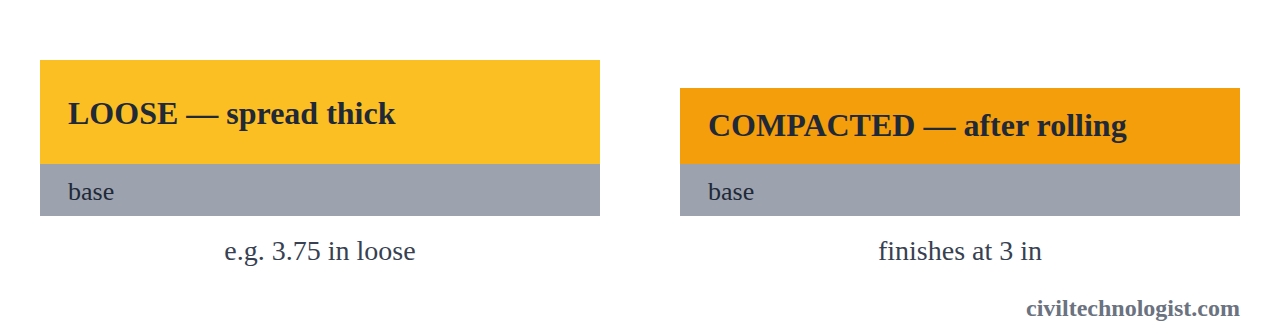
Asphalt is spread loose and then compacted by the roller — the standard rolldown factor for dense-graded hot mix is about 25% (NAPA Asphalt Paving Handbook, Section 7.5 — source: Asphalt Institute), so the paver lays the mat 25% thicker than the finished layer. For a 3-inch compacted layer the crew spreads about 3.75 inches loose (about 94 mm loose for a 75 mm layer); the handbook’s own example is a 2-inch compacted lift laid 2.5 inches thick. Open-graded mixes roll down less, about 15%. This margin does not change the tonnage — the same material is simply pressed down — which is why the weight is always calculated on the compacted thickness. It matters on site: set the screed and check the loose depth with a dipstick, or the finished layer comes out thin. This calculator shows the loose depth in every result; most online calculators never mention it.
Tips and Common Mistakes
- Calculating with the loose thickness — over-orders by about 25%. Always use the compacted (finished) thickness.
- Mixing up tons and tonnes — a US ton is 2,000 lb; a tonne is 1,000 kg. On a 15-ton order the mix-up is about 1.5 tons of material.
- Forgetting the waste extra — edges, spillage and uneven bases eat material. 5% minimum; 10% for hand-laid or rough ground.
- One rectangle for an L-shaped area — split it into rectangles and add the areas, or the tonnage is wrong both ways.
- Checking a contractor’s quote — run the same size and thickness here. If the quote is far above the order quantity with 10% waste, ask what the extra covers.
Quick Conversions
| From | To | Multiply by |
|---|---|---|
| feet | metres | 0.3048 |
| inches | mm | 25.4 |
| US tons | tonnes | 0.907 |
| tonnes | US tons | 1.102 |
| cubic yards | cubic metres | 0.765 |
FAQs
How much asphalt do I need for a driveway?
Multiply length by width by thickness, then by density. A 40 ft by 20 ft driveway at 3 inches needs about 14.5 US tons, or 15.2 tons with 5 percent waste.
How many square feet does one ton of asphalt cover?
At 145 lb/ft³: about 83 square feet at 2 inches thick, about 55 at 3 inches, and about 41 at 4 inches.
How many square metres does one tonne of tarmac cover?
At 50 mm, roughly 8 to 9 square metres, depending on density.
What is the density of asphalt?
Hot mix asphalt is usually about 145 lb per cubic foot, or roughly 2,320 kg per cubic metre.
What is the difference between a ton and a tonne?
A US ton is 2,000 lb, about 907 kg. A metric tonne is 1,000 kg. The calculator shows both.
What thickness should an asphalt driveway be?
Usually 2 to 3 inches (50 to 75 mm) on a well compacted base for cars, and 3 to 4 inches (75 to 100 mm) for heavier vehicles.
What is loose depth and why does it matter?
Asphalt is spread thicker than the final thickness, then rolled down. For dense-graded hot mix the loose depth is about 1.25 times the compacted thickness — the standard rolldown factor of about 25 percent (NAPA Asphalt Paving Handbook). The loose depth tells the crew how thick to spread it so the finished layer is the right thickness.
How much extra should I order?
Most people add 5 to 10 percent for waste, uneven ground and edges.
What is the difference between asphalt, tarmac and bitumen?
Asphalt is the mix of aggregate and bitumen. Tarmac is the UK name for a paved surface of this type. Bitumen is the binder that holds the stones together.
How many truckloads will I need?
Divide the total by the truck capacity. Common tipper trucks in the USA carry about 10 to 20 tons.
Can I use this calculator for a parking lot or road?
Yes. Add several areas and choose the correct thickness and density for the traffic.
How accurate is this calculator?
It gives an estimate based on the entered size and standard density. Ground levels, base and mix design change the real quantity, so confirm with your supplier.
How many tons of asphalt are in a cubic yard?
About 2 US tons. One cubic yard is 27 cubic feet, and at the standard compacted density of 145 lb/ft³ that is 27 × 145 = 3,915 lb, or 1.96 tons — roughly 2 tons per cubic yard. In metric, one cubic metre of compacted hot mix weighs about 2.32 tonnes.
Is blacktop the same as asphalt?
Yes. Blacktop is the everyday name for the same hot mix asphalt — crushed aggregate bound with bitumen. In the UK the same material is usually called tarmac or asphalt concrete. This calculator works for all of them.
How many square yards does one ton of asphalt cover?
At 3 inches compacted, one ton covers about 55 square feet, which is roughly 6 square yards. The trade rule of thumb is about 110 lb of asphalt per square yard for every inch of thickness, so one ton covers about 9 square yards at 2 inches and about 4.6 square yards at 4 inches.
How many tons of asphalt do I need for 1,000 square feet?
At the standard 3-inch driveway thickness and 145 lb/ft³, 1,000 sq ft needs 18.1 tons before waste — about 19 tons with a 5% waste allowance. At 2 inches it is 12.1 tons, and at 4 inches it is 24.2 tons.
Can you lay new asphalt over old asphalt or concrete?
Yes, if the existing surface is sound. This is called an overlay or resurfacing — usually 1.5 to 2 inches of new asphalt over a tack coat. If the old surface is badly cracked, settled or holding water, repair or mill those areas first, because cracks below will reflect through the new layer. Use this calculator with the overlay thickness to get the tonnage.
How long before you can drive on new asphalt?
You can walk on it the same day, but keep cars off for at least 24 to 48 hours — most pavers recommend 2 to 3 days, and longer in hot weather. The surface keeps hardening for 6 to 12 months, so avoid sharp steering turns and heavy point loads at first, and wait at least 6 months before sealcoating.
How much does a ton of asphalt cost?
It varies with crude oil prices, your region and the haul distance from the plant. Recent US guides put hot mix material at roughly $80 to $160 per ton at the plant, before delivery and laying; installed prices are considerably higher. UK prices are quoted per tonne and also vary by region. Enter the price your supplier quotes into this calculator to estimate your material cost.
Related Calculators
Concrete Calculator • Brick Calculator • Tile Calculator • Paint Calculator • Water Tank Calculator • Bitumen Extraction Test Calculator
Sources & note: Density and estimating practice follow common industry guidance (NAPA — National Asphalt Pavement Association — and Asphalt Institute estimating values). Loose-depth (rolldown) factor: NAPA Asphalt Paving Handbook, Section 7.5, source Asphalt Institute — about 25% for dense-graded mixes. Results are estimates for planning and quote-checking; confirm the final quantity with your asphalt supplier. Last updated: 23 November 2026 • By Mohsin Sahu, Civil Technologist.