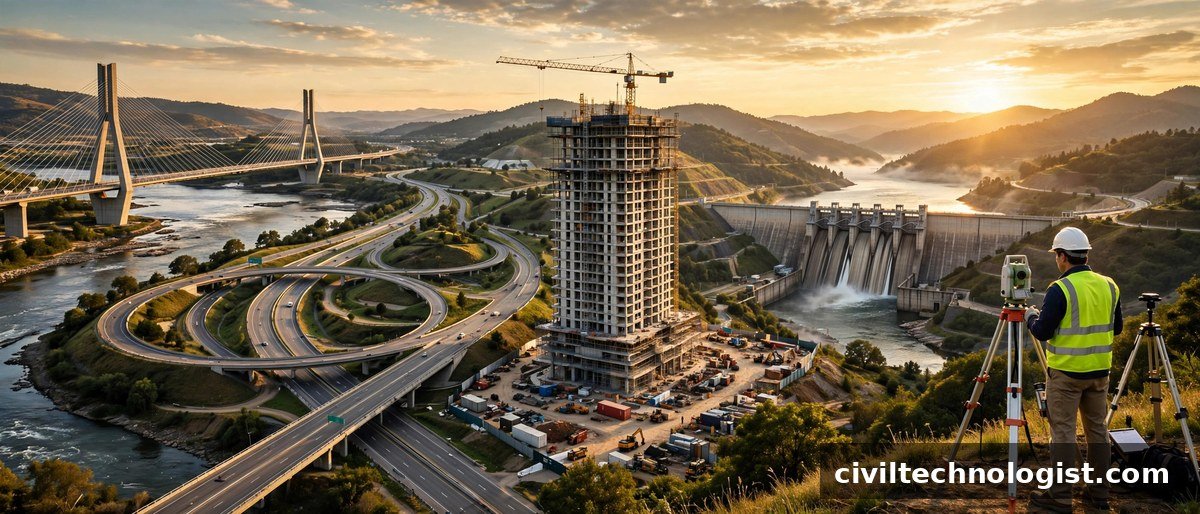
Civil engineering is the profession that designs, builds, and maintains the physical world we live in — roads, bridges, dams, buildings, water supply networks, and drainage systems. If it stands on the ground, carries traffic, or brings water to your tap, a civil engineer probably had a hand in it.
This article covers what civil engineering really is, how it grew from ancient construction into a modern profession, the main branches you should know, what civil engineers actually do day to day, and where the field is heading.
What Is Civil Engineering?
The word “civil” distinguishes this work from military engineering. A civil engineer plans, designs, constructs, supervises, and maintains infrastructure that serves the public — the “built environment.” That includes everything from a village culvert to a motorway interchange.
Unlike some engineering disciplines that live mostly in factories or software, civil engineering ends in structures you can walk on, drive across, and live inside. That is also why it carries heavy responsibility: mistakes in design or construction cost lives, not just money.
A Brief History of Civil Engineering
The Ancient World
People were doing civil engineering thousands of years before the term existed. The Great Pyramid of Giza (around 2560 BC) is essentially a materials-handling and geometry project on a staggering scale. The Romans were arguably the first true civil engineers in the modern sense: they built aqueducts that carried water across valleys on precise gradients, stone-paved roads that survived two thousand years, bridges, harbours, and sewer systems. Roman concrete — made with lime and volcanic ash — is the ancestor of the concrete we test and pour today.
The Birth of the Profession
The term “civil engineering” was coined in the 18th century by John Smeaton (1724–1792), an English engineer who wanted to distinguish his work from military engineering. Smeaton’s best-known project, the Eddystone Lighthouse, was completed in 1759 on a wave-battered rock off the English coast and stood for about 120 years. In 1771 he helped found the Society of Civil Engineers, the forerunner of today’s Institution of Civil Engineers (ICE), founded in London in 1818 with Thomas Telford as its first president. It was the world’s first professional engineering body.
The 19th century turned civil engineering into a science. Iron and then steel made long-span bridges and tall frames possible; Portland cement (patented 1824) made mass concrete construction practical. Railways, canals, dams, and sewerage systems reshaped cities across the world.
The Modern Era
The 20th and 21st centuries added reinforced and prestressed concrete, soil mechanics, computer-aided design, and now digital modeling. Today’s megaprojects — sea crossings, supertall towers, high-speed rail — rest on the same fundamentals the Romans and Smeaton worked with: gravity, materials, water, and soil.
The Six Main Branches of Civil Engineering
Most universities and industries divide civil engineering into these core branches. (There are many more specialisations — we list 20 sub-disciplines of civil engineering separately.)
| Branch | What it covers |
|---|---|
| Structural engineering | Design of buildings, bridges, towers, and dams so they carry loads safely |
| Geotechnical engineering | Soil and rock behaviour — foundations, slopes, retaining walls, ground improvement |
| Transportation engineering | Roads, highways, railways, airports, traffic planning and safety |
| Water resources engineering | Dams, canals, irrigation, drainage, flood control, water supply |
| Environmental engineering | Water and wastewater treatment, solid waste, pollution control |
| Construction management | Planning, costing, scheduling, and supervising the actual construction work |
On a small project, one engineer may cover several of these. On a large project, each branch is its own specialist team.
What Does a Civil Engineer Actually Do?
The job changes with the project phase:
- Planning and feasibility — Is the project needed? What will it cost roughly? What are the constraints?
- Surveying and investigation — Site surveys, soil testing, and collecting the data designs are based on.
- Design — Structural calculations, drawings, specifications, and bills of quantities.
- Construction supervision — Making sure the work matches the drawings and specifications: checking foundations, concrete quality, levels, and materials on site.
- Maintenance and repair — Inspecting existing structures and planning repairs before small problems become failures.
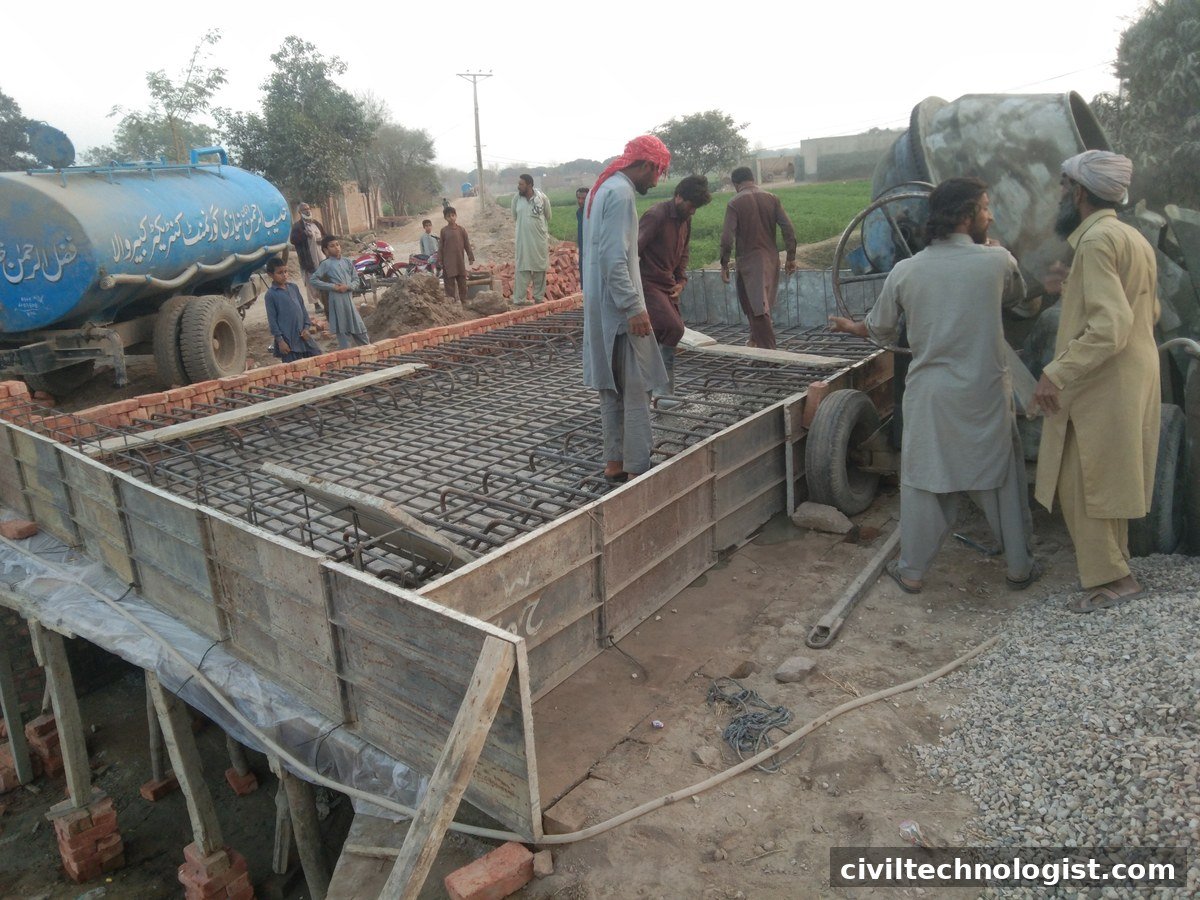
On site, a big part of the job is simply making decisions with incomplete information and keeping the work moving — checking a concrete pour, resolving a clash between drawings, or re-sequencing work when material delivery is delayed. The textbook is important, but judgement is what keeps a project alive.
The Future of Civil Engineering
Several trends are already changing how civil engineers work:
- BIM (Building Information Modeling) — 3D models that carry every detail of a structure, from reinforcement to maintenance schedules, replacing 2D drawings on major projects.
- Artificial intelligence — AI is entering design checks, construction scheduling, site monitoring, and defect detection. We cover this in detail in our article on AI in civil engineering.
- Sustainable materials — Low-carbon concrete, recycled aggregates, and supplementary cementitious materials (fly ash, slag) that cut the carbon footprint of construction.
- Smart infrastructure — Sensors embedded in bridges and dams that report stress, movement, and cracking in real time.
- Climate resilience — Designing drainage, flood protection, and structures for heavier rainfall and higher temperatures, which matters enormously in countries like Pakistan.
The tools will keep changing, but the core of the profession — building safe structures on real ground with real materials — is not going anywhere.
Frequently Asked Questions
What is civil engineering in simple words?
It is the engineering of the built environment: designing and building roads, bridges, buildings, dams, and water systems that society uses every day.
Who is called the father of civil engineering?
John Smeaton (1724–1792), the English engineer who coined the term “civil engineer” and built the Eddystone Lighthouse. He founded the Society of Civil Engineers in 1771.
What are the main branches of civil engineering?
Structural, geotechnical, transportation, water resources, environmental engineering, and construction management. Beyond these, the field has many specialist sub-disciplines.
Is civil engineering still a good career in 2026?
Infrastructure never stops needing engineers — maintenance alone guarantees long-term demand. The engineers who combine field experience with digital tools (BIM, data, AI-assisted workflows) have the strongest prospects.
What is the difference between a civil engineer and a civil engineering technologist?
A civil engineer typically follows a theory-heavy four-year engineering degree focused on design; a civil engineering technologist follows an applied, hands-on technology degree focused on implementation, testing, and site work. We explain this in full in our article on the difference between a civil engineer and a civil technologist.
Final Thoughts
Civil engineering is one of the oldest and most consequential professions in the world. Its history runs from Roman aqueducts to smart bridges, but the mission has never changed: build things that stand up, serve people, and last. If you are entering the field, learn the fundamentals deeply — loads, materials, soil, and water — because every future technology will still be built on them.
Written by Mohsin Raza Adil — BSc Civil Engineering Technologist (NTC-registered), Pakistan.

Mohsin Raza Adil
BSc Civil Engineering Technologist (NTC-registered), Pakistan. I write practical, field-tested guides on construction materials, soil testing and site engineering — the way it is actually done on site.



3 thoughts on “What Is Civil Engineering? History, Branches & Future (2026)”