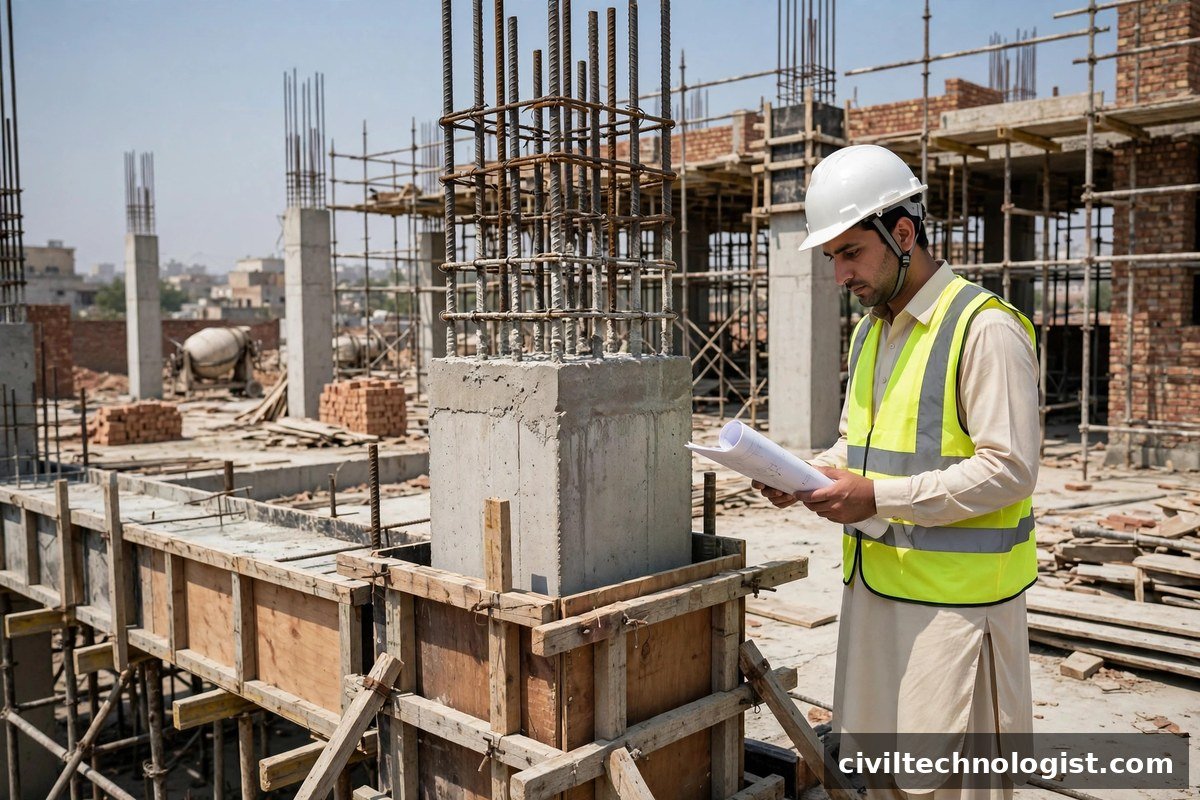
If you’ve ever wondered who actually makes sure the drawings become a real building — who checks the steel before the concrete is poured, who tests the soil, who measures the work for payment — you’ve been wondering about the civil engineering technologist’s job.
A civil engineering technologist is a professionally qualified practitioner trained in the applied side of civil engineering: construction execution, supervision, quality control, testing, surveying, and project documentation. The qualification is a four-year BSc Engineering Technology (Civil) degree (also awarded as B.Tech / BS Technology in some institutions), and in Pakistan, graduates register with the National Technology Council (NTC).
This article explains what technologists actually do day to day, who hires them, how to become one, how the qualification is recognized in Pakistan and abroad, and how the role differs from a civil engineer (covered in detail in our comparison article).
The Role in One Sentence
The civil engineer designs the work; the civil engineering technologist makes sure it is built correctly, tested properly, and recorded honestly.
Core Responsibilities
1. Site Supervision and Execution
This is the heart of the job. The technologist supervises daily construction activity and makes sure it follows the approved drawings and specifications:
- Setting out works and checking levels and alignment before construction starts.
- Supervising excavation, formwork/shuttering, reinforcement fixing, and concreting.
- Checking concrete pours — mix proportions on site, slump, compaction, and curing.
- Coordinating with the foreman, steel fixers, masons, and machine operators.
- Verifying that materials delivered match the approved samples and specifications.
Practical note: The most valuable site habit on any project is simple: check the steel before the pour, not after. Once concrete is in the formwork, a missing bar or wrong spacing is buried forever. A technologist who does pre-pour checklists properly saves the project from its most expensive mistakes.
2. Quality Control and Testing
Technologists run and interpret the tests that prove the work meets the specification:
- Concrete: sampling cubes/cylinders, slump tests, compression testing at 7 and 28 days.
- Soil and compaction: field density tests (sand cone method), speedy moisture tests, Proctor compaction reference tests in the lab.
- Aggregates and materials: sieve analysis, silt content, cement and steel verification against approved brands and standards.
- Maintaining test registers, preparing QC reports, and flagging non-conforming work before it gets covered up.
For the full picture of the tests involved, see our complete list of soil tests used in civil and geotechnical engineering.
3. Surveying and Setting Out
Total stations, auto levels, and GPS equipment are everyday tools for technologists:
- Establishing benchmarks and control points on site.
- Setting out building grids, road centerlines, and invert levels for pipelines and drains.
- Checking completed work against levels — subgrade, base course, and finished road levels.
- Recording as-built measurements.
4. Estimation, Measurement, and Billing
- Preparing bar bending schedules (BBS) from structural drawings.
- Taking measurements of executed work for interim (running) bills and final bills.
- Preparing quantity estimates for small works and variations.
- Maintaining measurement books and site records that auditors will read years later.
5. Documentation and Reporting
- Daily progress reports, labour and material records, equipment logs.
- Maintaining drawing registers — making sure the site always works from the latest issued drawing.
- Preparing method statements and checklists for waterproofing and other repetitive operations.
- Photographic records of concealed work (foundations, reinforcement, waterproofing) before covering.
6. Safety, Scaffolding and Site Management
- Enforcing basic site safety: edge protection, excavation shoring awareness, safe scaffolding, PPE use.
- Managing stores — cement stock rotation (first in, first out), steel storage off the ground, material reconciliation.
- Coordinating subcontractors and keeping the programme on track.
Where Do Civil Engineering Technologists Work?
Typical employers in Pakistan:
- Contractors — the largest employer: building contractors, road contractors, piling and infrastructure firms. Site engineer, site supervisor, and QC engineer posts.
- Consultants — supervision teams on site: assistant resident engineer (site), inspector, and materials/lab engineers.
- Government departments — public works (C&W), highways, irrigation, public health engineering, municipal corporations, development authorities. Posts are filled according to recruitment rules that recognize the technology qualification.
- Materials testing laboratories — commercial and institutional labs: lab engineer, lab in-charge, field testing teams.
- Specialized firms — surveying companies, piling contractors, precast concrete producers, asphalt plants, ready-mix concrete suppliers.
- Self-employment — experienced technologists run small contracting firms, surveying services, or independent QC/testing consultancies.
The Education Pathway (Pakistan)
The verified route, step by step:
- Entry qualification — FSc (Pre-Engineering), ICS, or DAE (Diploma of Associate Engineer). NTC’s minimum admission criteria: at least 50% marks plus the institution’s entry test.
- Degree — 4-year BSc Engineering Technology (Civil), typically 130–140 credit hours, from an institution whose technology programme is accredited by the National Technology Council (NTC), which operates under HEC.
- Registration — Apply to NTC for registration as a Graduate Engineering Technologist (HEC-attested degree and transcript required; nominal lifetime registration fee). With five years of relevant experience and experience certificates, upgrade to Professional Engineering Technologist.
Practical note: If you’re a DAE holder considering the BSc Technology route, it is genuinely worth it — but verify before admission that the programme is NTC-accredited and that your intake batch will be eligible for registration. This one check protects your entire investment in the degree.
Engineering Technology Around the World: Country-by-Country Comparison
The “engineering technologist” is not a Pakistani invention — it is an internationally recognized occupational category. The Sydney Accord (2001) is the international agreement under which signatory countries recognize each other’s accredited engineering technology qualifications as substantially equivalent. (The better-known Washington Accord covers professional engineering degrees instead — Pakistan, through PEC, is a Washington Accord signatory, but not a Sydney Accord signatory.) How the technologist fits into each country:
| Country | Typical qualification | Professional title | Accreditation / registration body | International accord |
|---|---|---|---|---|
| Pakistan | 4-year BSc Engineering Technology (130–140 credit hours) | Graduate / Professional Engineering Technologist | National Technology Council (NTC) under HEC | Not a Sydney Accord signatory |
| Australia | 3-year Bachelor of Engineering Technology | Engineering Technologist | Engineers Australia | Sydney Accord founding signatory (2001) |
| Canada | 2–3 year technology diploma/degree | Certified Engineering Technologist (C.E.T.) | Provincial associations (e.g. OACETT in Ontario); Technology Accreditation Canada | Sydney Accord founding signatory (2001) |
| United Kingdom | Accredited engineering technology degree | Incorporated Engineer (IEng) | Engineering Council (UK) | Sydney Accord founding signatory (2001) |
| USA | 4-year BS in Engineering Technology | Engineering Technologist | ABET (accreditation); state boards handle licensing | Sydney Accord signatory (2009) |
| Malaysia | 4-year Bachelor of Engineering Technology (accredited) | Professional Technologist (Ts., P.Tech.) | Malaysia Board of Technologists (MBOT) under the Technologists and Technicians Act 2015; BEM also registers Engineering Technologists | Not a Sydney Accord signatory |
| Hong Kong | Accredited Higher Diploma / technology qualification | Associate Member of HKIE (AMHKIE) — “a fully qualified engineering technologist” | Hong Kong Institution of Engineers (HKIE) | Sydney Accord founding signatory (2001) |
| Ireland | Accredited engineering technology degree | Associate Engineer | Engineers Ireland | Sydney Accord founding signatory (2001) |
| New Zealand | Accredited engineering technology qualification (Sydney Accord / 3-year BEngTech pathway) | Chartered Member — Engineering Technologist | Engineering New Zealand | Sydney Accord founding signatory (2001) |
| South Africa | Accredited technology qualification | Professional Engineering Technologist | Engineering Council of South Africa (ECSA) | Sydney Accord founding signatory (2001) |
| South Korea | ABEEK-accredited engineering technology program | — | Accreditation Board for Engineering Education of Korea (ABEEK) | Sydney Accord signatory (2013) |
| Taiwan (Chinese Taipei) | IEET-accredited engineering technology program | — | Institute of Engineering Education Taiwan (IEET) | Sydney Accord signatory (2014) |
What the comparison shows: everywhere, the technologist sits between the technician and the professional engineer — hands-on, application-focused, and site/lab-oriented. The difference is recognition: in Sydney Accord countries the qualification carries international mobility and a clear professional title, while in Pakistan and Malaysia the national frameworks (NTC and MBOT registration) exist but Sydney Accord membership — and with it automatic international recognition — is still missing. For Pakistani technologists, this is exactly why NTC registration, documented site experience, and any internationally recognized certifications matter — they are the bridge to that global framework.
Skills That Make a Good Technologist
- Drawing reading — the ability to read architectural, structural, and services drawings fluently, and to spot clashes between them.
- Practical judgment — knowing when a specification matters absolutely (concrete cover, compaction) and when a pragmatic site solution is acceptable.
- Testing discipline — sampling correctly, labelling properly, and recording results honestly. A test result nobody trusts is worse than no test.
- Measurement accuracy — billing disputes are won and lost on measurement records.
- Communication — giving clear instructions to foremen and labour, writing reports the client can act on, and pushing back politely when pressure comes to compromise quality.
- Software basics — AutoCAD for reading and marking up drawings, Excel for BBS and billing, and increasingly surveying/GIS tools.
Technologist vs Engineer vs DAE: Don’t Confuse the Three
- DAE (Diploma of Associate Engineer): 3-year diploma after matric — technician level. Supervisors, draftsmen, junior site staff.
- BSc Engineering Technology: 4-year degree — technologist level. Site engineers, QC engineers, lab engineers.
- BSc/BE Engineering: 4-year degree — engineer level, PEC-registered. Design engineers, consultants, sign-off authority.
Each level has its place; the problems start when employers expect degree-level design responsibility from a diploma, or treat a technologist as “just a supervisor.” Read the full civil technologist vs civil engineer comparison for the detailed breakdown.
Frequently Asked Questions
What is the salary of a civil engineering technologist in Pakistan?
It varies widely with sector, city, and experience — site engineers in contracting typically start modestly and rise fast with proven QC and execution skills. Rather than quoting a number that will be outdated in a year, the honest advice is: technologists who master testing, billing, and site management are rarely out of work.
Is BSc Engineering Technology a good career choice?
It is a strong choice if you enjoy practical, hands-on work and want to be on construction sites and in laboratories. It is a poor choice if your goal is structural design or PEC registration — choose BSc Engineering for that.
Can a technologist become a project manager?
Yes. With experience, technologists routinely progress to senior site engineer, project coordinator, and project manager roles in contracting firms, where execution and commercial management matter more than design theory.
Does NTC registration expire?
NTC registration as a Graduate Engineering Technologist is issued on payment of a lifetime registration fee — but always confirm current fee and documentary requirements on the NTC website before applying, as procedures are updated from time to time.
Can I do an MS/MSc after BSc Engineering Technology?
Yes — and the route is opening wider in Pakistan. HEC’s Graduate Education Policy allows admission to a master’s in a different but relevant discipline where the university permits it (usually with a few deficiency courses). The NTC has been encouraging engineering universities to admit B.Tech/BSc Technology graduates into M.Eng/MSc programmes after assessment, and current admission guides (for example, the University of Lahore’s 2025–26 guide) list MSc Civil Engineering eligibility as “BS Civil Engineering or other relevant discipline” — wording that can include technology graduates. It is not yet a blanket national rule: always check the specific university’s current eligibility criteria before applying.
Final Thoughts
The civil engineering technologist is the person standing between the drawing and the finished structure — checking, testing, measuring, and documenting. It’s hands-on, responsibility-heavy work, and done well, it’s what separates buildings that last from buildings that merely look finished. If that’s the kind of work you want, the path is clear: accredited programme, NTC registration, and then the real education begins — on site.
Written by Mohsin Raza Adil — BSc Civil Engineering Technologist (NTC-registered), Pakistan.

Mohsin Raza Adil
BSc Civil Engineering Technologist (NTC-registered), Pakistan. I write practical, field-tested guides on construction materials, soil testing and site engineering — the way it is actually done on site.