Civil engineering has a gender problem, and the numbers prove it. But it also has something else: a genuine, growing space for women engineers — in design offices, laboratories, planning departments, site management, and academia. This article looks at both sides honestly: where women stand in the profession as of 2026, where the real opportunities are, what the genuine challenges look like, and what actually helps.
Where Women Stand in the Profession: The Numbers (as of 2026)
Let us start with facts, because feelings on this topic run strong in both directions.
- United States: Women accounted for 11.3% of the construction workforce in 2025 — the highest share in 20 years, according to the US Census Bureau’s Current Population Survey, reported by the National Association of Home Builders in September 2026. Around 1.37 million women now work in the industry. However, most are concentrated in office, administrative, and management roles: women make up just 4% of workers in construction and extraction occupations (the trades and site labour categories).
- Australia: Women make up about 13% of the construction workforce, with only around 3% in trades, according to research from Adelaide University published in 2026.
- United Kingdom: The construction workforce is roughly 15% female, but on-site trades sit at just 1–2%.
The pattern is consistent worldwide: women are entering the industry in growing numbers, but they remain heavily under-represented in field and trade roles, and better represented in professional, technical, and office-based engineering work.
Practical note: These statistics cover construction broadly, not civil engineering graduates specifically. Among university civil engineering cohorts, female enrolment is typically much higher — often 20–40% depending on the country — but the numbers thin out between graduation and senior industry roles. That gap is the real story.
Real Opportunities for Women in Civil Engineering
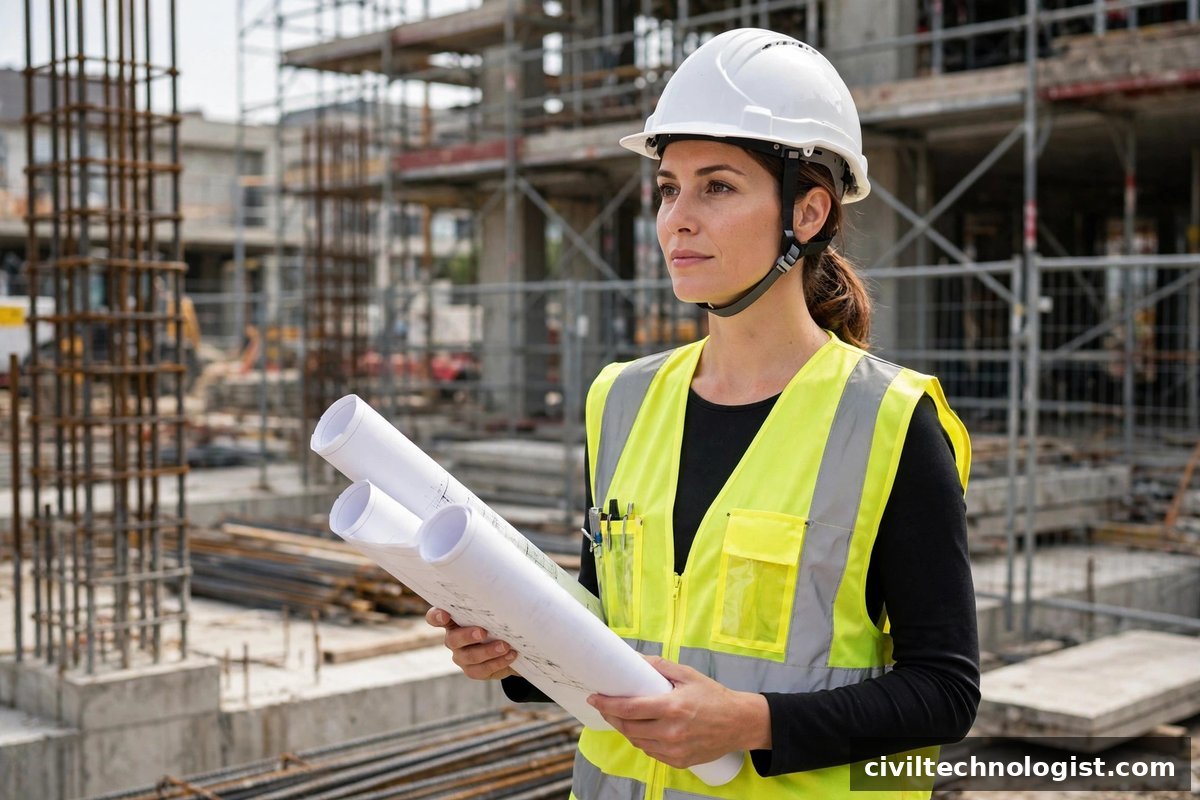
Civil engineering is a wide field, and many of its roles suit anyone with the right skills — regardless of gender. Here are the areas where women engineers are building strong careers today:
Structural and design engineering
Design offices are among the most accessible entry points. Structural design, drafting, and detailing reward analytical skill and precision — and remote/hybrid design work has expanded significantly, giving more flexibility than site-based roles.
Planning and project controls
Planning engineers, schedulers, and project controls specialists are in chronic shortage worldwide. These roles combine engineering knowledge with software skills (Primavera P6, MS Project) and are largely office-based — an attractive path for engineers who want influence over projects without permanent site posting.
Materials laboratories and QA/QC
Testing laboratories — concrete, soil, asphalt, aggregate — employ large numbers of women engineers, particularly in the Middle East and South Asia. QA/QC roles combine lab work with site inspection and offer a clear path into quality management.
Academia and research
Universities and research institutions offer structured career progression, and civil engineering departments worldwide are actively working to recruit and retain female faculty. For engineers who enjoy teaching and research, this is a well-established route.
Environmental and water engineering
Water supply, sanitation, wastewater treatment, and environmental assessment are growth areas globally — and they attract strong female participation, partly because the work connects directly to public health and community outcomes.
Site engineering and project management
Site roles remain the toughest environment (see challenges below), but they are also where the fastest career growth happens in construction. Women who do take the site route — and succeed — frequently report that the experience accelerated their careers beyond what office roles could offer. The barrier is real, but so is the payoff.
Entrepreneurship and consulting
Experienced women engineers are increasingly founding their own consultancies — in design, estimation, testing services, and project management. Small testing labs and design offices have relatively low startup costs and reward reputation over size.
Practical note: When choosing a specialization, weigh genuine interest first and “suitability” second. The engineers — women and men — who last in this profession are the ones who actually enjoy the work.
Genuine Challenges (Stated Honestly)
It would be dishonest to pretend the obstacles do not exist. Here they are, plainly:
Site culture
Construction sites in many countries run on a rough, male-dominated culture. A woman engineer on site may face anything from protective over-politeness (being shielded from “difficult” work, which slows her learning) to outright hostility and harassment. This is the single biggest reason many women engineers avoid or leave site roles.
Safety and facilities
A practical, under-discussed issue: many sites lack separate toilets and changing facilities for women, and standard PPE (helmets, boots, vests) is often designed for male bodies. These are solvable problems — and progressive contractors are solving them — but they remain common on smaller projects.
Work-life balance
Site roles often demand long hours, remote postings, and unpredictable schedules. This affects everyone, but it hits harder where social expectations still place most family responsibilities on women. Flexible and hybrid roles in design, planning, and BIM are partly a response to this reality.
The “prove yourself twice” effect
Many women engineers report having to demonstrate competence repeatedly in ways their male colleagues do not — having instructions questioned, decisions second-guessed, or technical knowledge tested informally. It is tiring, and it is real.
Mentorship gaps
With few women in senior positions, junior women engineers often lack mentors who have navigated the same path. This matters: mentorship strongly predicts retention and promotion in engineering.
Pay and progression
Where transparency is lacking, pay gaps persist. The fix is structural — transparent pay scales, objective promotion criteria — but individual engineers can protect themselves by researching market rates (see our civil engineer salary guide) and negotiating from data.
None of these challenges means women should avoid civil engineering. They mean the industry still has work to do — and that women entering it should go in with open eyes and a plan.
What Actually Helps: Practical Advice
For women engineers and students:
- Build undeniable technical competence. The “prove yourself twice” effect fades fastest against engineers whose work is visibly excellent. Master your codes, your software, and your site fundamentals.
- Find mentors — of any gender. A good mentor who understands the industry matters more than a mentor who shares your gender. Professional associations, alumni networks, and LinkedIn are all fair game.
- Choose your first employer carefully. Company culture varies enormously. During interviews, ask directly: how many women engineers work here? Are there women in site roles? What are the site facilities like? The answers tell you everything.
- Learn to document. Keep records of your achievements, decisions, and contributions. In environments where credit is unevenly distributed, a paper trail protects you.
- Know your rights. Harassment protections exist in most countries’ labour law. Know what yours says before you need it.
For employers and site managers:
- Fix the basics first. Separate toilets, properly fitting PPE, and safe transport to remote sites cost little and signal everything.
- Set objective promotion criteria. When advancement depends on measurable performance rather than “fit,” everyone benefits — not just women.
- Zero tolerance, visibly enforced. A harassment policy that exists only on paper is worse than useless. Act on complaints promptly and visibly.
- Hire in cohorts, not tokens. One woman on a 50-person site is isolation; several is a normal workplace.
Notable Contributions
Women’s contributions to civil engineering are not new — they are just under-taught. Emily Warren Roebling effectively directed the completion of the Brooklyn Bridge (1883) after her husband, the chief engineer, was incapacitated — managing the engineering correspondence, materials testing oversight, and on-site decision-making for over a decade. She was the first person to cross the bridge at its opening.
In the modern era, women lead major infrastructure programmes, head engineering faculties, and run construction firms worldwide — from metro rail projects to dam authorities. The point is not that women can do civil engineering; history already settled that. The point is how many more could, if the barriers came down.
Frequently Asked Questions
Is civil engineering a good career for women?
Yes — with open eyes. Design, planning, laboratory, environmental, and academic roles offer strong careers with fewer of the site-culture challenges. Site roles are tougher but offer faster growth. The right choice depends on your interests and circumstances, not your gender.
What percentage of civil engineers are women?
It varies by country and by how you count. In construction workforces overall, women are roughly 11–15% in the US, UK, and Australia (as of 2025–2026 data), with much lower shares in site trades. Among civil engineering graduates, female shares are typically higher — but retention through mid-career remains the industry’s weak point.
Which civil engineering field is best for women?
There is no “best field for women” — there are fields with different work patterns. Structural design, planning/project controls, environmental engineering, and academia tend to offer more predictable hours and office-based work. But plenty of women thrive in site engineering and project management too. Choose by interest and temperament.
How can the industry attract more women?
Research (including a 2026 Adelaide University study) points to the same answers repeatedly: safer and more inclusive workplaces, flexible arrangements, visible career pathways, properly fitting PPE and facilities, and female role models in senior roles. Salary alone is not enough — culture matters more.
Final Thoughts
The numbers tell a clear story: women are entering civil engineering and construction in record numbers, yet the profession still loses too many of them to culture, facilities, and inflexible work patterns. The opportunity is enormous — the industry faces persistent skills shortages, and half the population is an untapped reservoir of talent.
For women considering this path: the challenges are real but navigable, the work is genuinely rewarding, and the engineers who came before you — from Emily Roebling on the Brooklyn Bridge to the project directors running today’s mega-projects — proved long ago that this profession belongs to anyone with the skill and determination to practice it.
Written by Mohsin Raza Adil — BSc Civil Engineering Technologist (NTC-registered), Pakistan.

Mohsin Raza Adil
BSc Civil Engineering Technologist (NTC-registered), Pakistan. I write practical, field-tested guides on construction materials, soil testing and site engineering — the way it is actually done on site.